


































































Sharjah-based budget carrier Air Arabia reported a 51 per cent decline in net profit for the first half of 2026, reaching Dh374 million. This downturn was primarily driven by regional conflict, which disrupted flight schedules, necessitated reduced operating capacity, and pushed fuel prices to record highs.
For the six-month period ending June 30, the airline generated revenue of Dh3.48 billion, representing a 1 per cent decrease compared to the Dh3.52 billion recorded during the same period in 2025. The carrier transported more than 8.7 million passengers across its global hubs, marking a 14 per cent year-on-year decline attributed to these ongoing operational constraints.
Despite carrying fewer passengers, the airline maintained an average seat load factor of 83 per cent. This metric measures the proportion of available seats filled by passengers and indicates that demand remained relatively strong across its network, even as the airline navigated a challenging geopolitical environment.
The impact of these regional tensions has been felt across the global airline industry. Austrian Airlines, for instance, reported a €93 million adjusted EBIT loss in the first half of 2026, with the Middle East conflict pushing its fuel costs more than €60 million higher than a year earlier. Pegasus Airlines also swung to an operating loss in the second quarter, while Philippine Airlines reported a $25.1 million net loss for the first half.
The broader industry pressure is reflected in IATA forecasts, which suggest that Middle Eastern airlines will transition from a $7.2 billion profit in 2025 to a $4.3 billion loss in 2026. This strain was particularly pronounced during the second quarter for Air Arabia, which saw its net profit fall 77 per cent to Dh96 million, while quarterly revenue dipped 3 per cent to Dh1.68 billion.
During the second quarter, the airline carried more than 3.9 million passengers, a 23 per cent drop year-on-year, with an average seat load factor of 81 per cent. Air Arabia Chairman Sheikh Abdullah Bin Mohammad Al Thani stated that the airline’s ability to remain profitable reflects the resilience of its business model and financial position despite the significant impact of airspace closures and rising operating costs.
He added that the airline remains focused on maintaining network connectivity and controlling costs while preserving operational efficiency. Despite the disruption, Air Arabia expanded its fleet by six aircraft during the first half, bringing its total to 96 owned and leased Airbus A320 and A321 aircraft. The carrier also launched five new routes across its hubs in the UAE, Morocco, Egypt, and Pakistan.
Looking ahead, Air Arabia expressed confidence in its business fundamentals as market conditions improve. Sheikh Abdullah emphasized that the airline remains committed to serving customers, expanding its network responsibly, and creating sustainable long-term value for all stakeholders, supported by a disciplined financial approach.
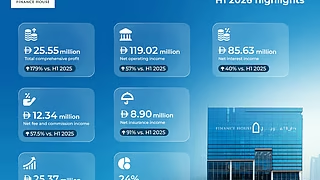
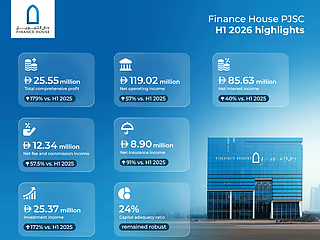
In the wider UAE business landscape, other firms have shown varied results: Finance House PJSC posted a 179 per cent surge in H1 2026 profit, Dana Gas saw its H1 profit rise 47 per cent to Dh393 million, Aramex achieved record Q2 revenue of Dh1.83 billion, and Mashreq reported a record H1 profit before tax of Dh4.8 billion.
Source: Gulf News