














































Shanghai arrives in one’s consciousness long before the physical journey begins. My mental image of the city was a collage of neon-lit glass towers and relentless energy, yet my actual arrival in mainland China offered a different perspective. After an efficient transit through immigration, I traveled through the darkness toward Changshu, a journey that felt disconnected from the industrial hubs of Solihull or Stuttgart.
My stay at the Garrya Yangcheng Lake Hotel provided a serene contrast to the bustling automotive world I was about to enter. The first sign that I had stepped into a new era of industrial operation appeared in the hotel corridors. Small robots — looking remarkably like miniature versions of Star Wars’ R2-D2 — quietly navigated the hallways delivering room service. They moved with an eerie, calculated confidence, signaling that technology was already performing extraordinary tasks in the background of daily life.
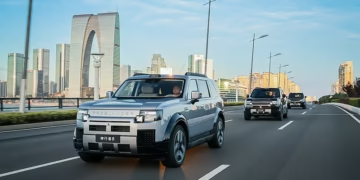
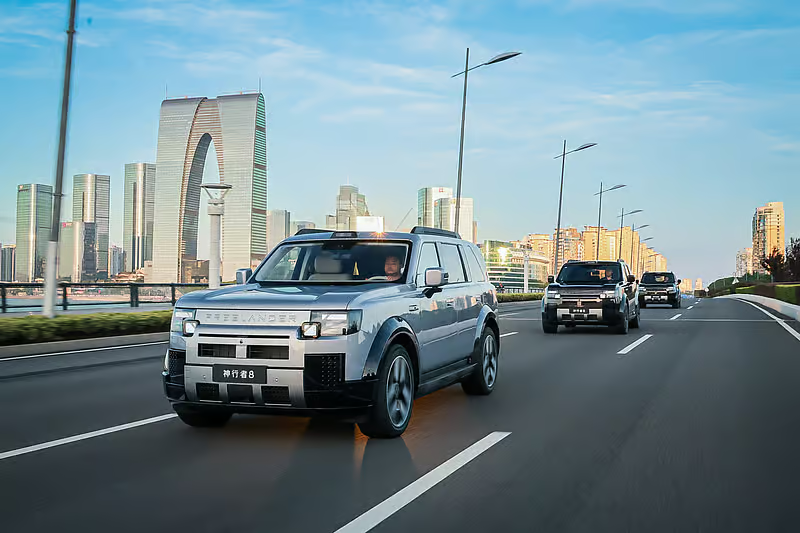
This experience served as a precursor to the main event. Along with a small group of Middle Eastern journalists, I had been invited by the Freelander team for an exclusive behind-the-scenes look at the company ahead of the Middle East launch of the all-new Freelander 8 later this year. The anticipation was palpable as we prepared to witness the manufacturing heart of this upcoming model.
The Freelander Super Factory in Changshu is less an industrial plant and more a dedicated city for vehicle production. Supported by investments exceeding US$3.1 billion, including significant upgrades for intelligent new energy vehicle manufacturing, it represents Jaguar Land Rover’s first full vehicle production facility outside the UK, combining British engineering heritage with Chery’s expertise in advanced manufacturing.
Stepping onto the production floor, the scale of the operation is immediately striking. More than 1,100 intelligent robots choreograph an industrial ballet with astonishing precision. Massive robotic arms swing through the air, manipulating doors, engines, and chassis components with effortless grace. Sparks cascade across welding stations like fireworks, while conveyor systems move partially assembled vehicles through their evolutionary stages.
The human element remains central to this high-tech environment. Hundreds of engineers and technicians work in tandem with the automation, ensuring that technology amplifies rather than replaces human craftsmanship. Sophisticated tools monitor tolerances down to fractions of a millimetre, and interior assembly is handled with the meticulous care typically reserved for luxury furniture production.
The facility operates under a philosophy where every measurable process is monitored and continuously improved. Digital quality systems follow every vehicle throughout production, ensuring a rigorous standard of excellence. Every Freelander 8 undergoes exhaustive testing before it leaves the factory floor, including rain simulations four times heavier than a natural storm, battery sealing tests, and precise ADAS calibration.
These verification processes are critical for the vehicle’s global performance. Whether the Freelander 8 is destined for the streets of Abu Dhabi, Dubai, or other international markets, the factory ensures it is prepared to handle diverse and demanding conditions. The commitment to quality is embedded in every stage of the assembly line.
Beyond the mechanical output, the factory demonstrates a significant commitment to sustainability. Intelligent energy management systems, advanced water recycling, and low-carbon production technologies are integrated throughout the site. This approach highlights how modern manufacturing successfully balances engineering excellence with environmental responsibility.
Our visit was not a staged showroom experience; we witnessed production exactly as it occurred. Amidst the sparks, the noise, and the organized chaos of thousands of individual processes, it became clear that the Freelander 8 is the product of a highly sophisticated industrial ecosystem. By the time we emerged several hours later, the vehicle had become far more than just another new model preparing to enter the UAE market; it was a testament to a new era of global automotive manufacturing.
It was my first introduction to a recurring theme over the next 48 hours: technology quietly doing extraordinary things.
There are certain places in the world that arrive long before you do.
Before I’d even landed, I already had a mental image carefully assembled from films, newspaper headlines and social media reels.
I’d been to Hong Kong countless times, but never ventured into mainland China, so I arrived with a mixture of curiosity and mild apprehension.
Stay up to date with the latest news.
My driver, cheerful despite the late hour, reflected on the difficult years of Covid that had so profoundly affected China before delivering me to the Garrya Yangcheng Lake Hotel — a beautiful lakeside retreat so peaceful it felt less like a hotel and more like somewhere designed for monks recovering from burnout.
The first indication that I wasn’t in Solihull came moments later.
They never complained, never asked for tips and somehow managed to avoid every guest with an eerie confidence that suggested humanity may already be on borrowed time.
After the inevitable ceremonies, speeches and photographs that accompany occasions like these, we reached the part everyone had really come for.
Or perhaps “factory” doesn’t quite do it justice.
Inside, it is impossible not to be impressed.
The human workforce is equally impressive.
What struck me most was the relentless attention to detail.
Equally impressive is the factory’s sustainability programme.
Perhaps the most reassuring takeaway was that this wasn’t a carefully choreographed showroom experience.
You weren’t simply driving a new SUV.
You were driving the remarkable sum of everything you’d just witnessed.
Source: Khaleej Times