













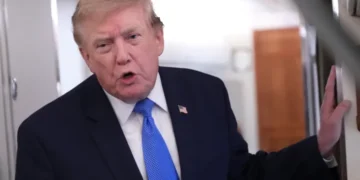





































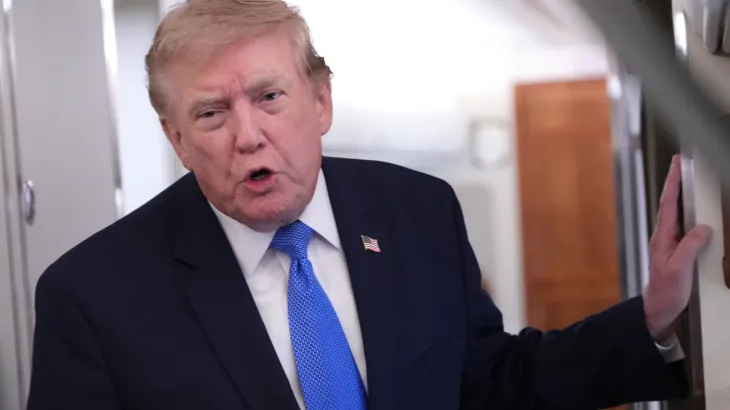
United States President Donald Trump told reporters on Sunday that an agreement with Iran is imminent and that new negotiations were set to begin on Monday. As he was returning to Washington, DC, from a weekend in New Jersey, Trump revealed he had called off what he described as “massive strikes” against Iran. He characterized the aborted military action as the “biggest attack since World War II,” emphasizing that he opted for diplomacy over destruction.
The president did not provide any specific details regarding where these potential talks would take place or which parties would participate in the process. When reporters pressed him on whether a formal deadline existed for reaching an agreement, Trump declined to provide a definitive timeline.
Instead, he responded: “Would I rather make a deal? I’m not looking to kill people because people die, a lot of people die, and we don’t want that.” He further clarified the scope of the potential breakthrough, stating, “And the deal is imminent, having to do with the Hormuz Strait and ultimately the denuclearisation of Iran.”
Reporting from the Qatari capital, Doha, on Monday, Al Jazeera’s Osama Bin Javaid noted that shortly before Trump’s announcement, an unnamed source hinted that mediators were preparing to fly to Tehran to facilitate an indirect negotiation session. Bin Javaid added that the talks would likely focus on ongoing discussions between Iran and Oman regarding control of the critical Strait of Hormuz.
Regarding the logistical framework of these efforts, Bin Javaid reported: “We’re hearing from our sources that the Pakistani interior minister and especially the Qataris are going to be sending emissaries so that this can take place as soon as possible.” He further noted the uncertainty surrounding the process, stating, “We don’t know the specific details, but we do know something is in the making.”
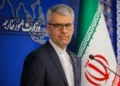
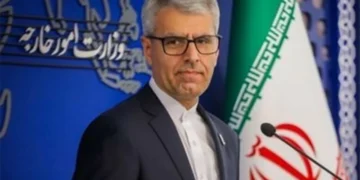
However, the diplomatic outlook shifted on Monday when Esmaeil Baghaei, spokesman for the Iranian Foreign Ministry, issued a firm rejection of hosting foreign delegations. “We are not going to host a delegation or be guests of a country during these days,” Baghaei stated during a news conference. It remains unclear if this refusal applies only to direct talks or if it also encompasses indirect mediation efforts.
Reporting from Tehran, Al Jazeera’s Tohid Asadi confirmed that Iran is engaged in bilateral discussions with Oman. “Indeed, Iran is talking to the Omanis,” Asadi said. “They are saying that all these talks are focused on reopening the Strait of Hormuz. Iran is conducting the talks in a bilateral way, denying any potential foreign intervention in that regard.”
Trita Parsi, executive vice president of the Quincy Institute for Responsible Statecraft, told Al Jazeera that Trump’s pattern of escalating tensions and then abruptly canceling attacks has damaged the prospects for a durable settlement. “I think this has become somewhat of a tiresome pattern,” Parsi said. “At some point, all credibility for negotiations is going to be lost. The credibility of actually sticking to a deal is questionable.”
Alan Eyre, a distinguished diplomatic fellow with the Middle East Institute in Washington, DC, suggested that the only substantive talks occurring are those conducted through regional intermediaries. He explained that Tehran has concluded that direct engagement with the US is futile because it believes it cannot rely on American commitments.
Despite the talk of diplomacy, US officials maintain that military options remain on the table. US Secretary of Defense Pete Hegseth reiterated the president’s claim that the Pentagon was prepared to execute an attack at “levels not seen since World War II.” Hegseth further emphasized the military posture in an X post on Monday, stating that the US remains “locked and loaded.”
The financial markets reacted sharply to the shifting geopolitical climate. Oil prices fell by more than $4 a barrel after Trump announced the cancellation of his planned strikes on Iranian infrastructure. Brent crude futures slid $4.08, or 4.64 percent, to $83.85 per barrel late on Sunday, while West Texas Intermediate crude dropped $4.01, or 4.74 percent, to $80.66 a barrel.
The situation remains fluid as international observers monitor whether the reported back-channel communications can overcome the public posturing between the two nations. While the prospect of a limited agreement regarding the Strait of Hormuz has been raised, the path toward broader denuclearization and a lasting peace remains fraught with significant diplomatic hurdles and mutual distrust.
It was essentially closed by Iran in early March after the US and Israel began their air strikes on February 28.
Iran allowed few ships to pass through the strait until it signed a memorandum of understanding with the US on June 17.
“Some progress has been achieved,” he said, adding that talks with officials from the region and outside the region are being held as well.
And obviously, the credibility of the threats is degraded.”
President Trump has promised to annihilate Iran five or six times and then backs down at the last minute.
Do I think that there’s an actual agreement on the nuclear issue?
The critical waterway, through which one-fifth of the world’s oil and liquefied natural gas supplies were shipped before the US-Israel war on Iran began, has become the most urgent issue on the agenda for talks with the US.
However, the vague wording of that agreement triggered a dispute over which routes ships should take, and Iran attacked several ships that were following an Oman-approved route through the southern part of the waterway.
The strait was then closed again last week, and the US restarted its naval blockade on Iranian ports.
Last week, Oman presented a proposal backed by other Gulf countries for the future management of the strait to Iran, which rejected it and made counterproposals.
Iran’s state media reported on Sunday that Araghchi had spoken by phone with his Saudi counterpart, Prince Faisal bin Farhan Al Saud, and Pakistan’s military chief, Field Marshal Asim Munir, to discuss diplomacy to resolve the crisis.
Source: Aljazeera