































































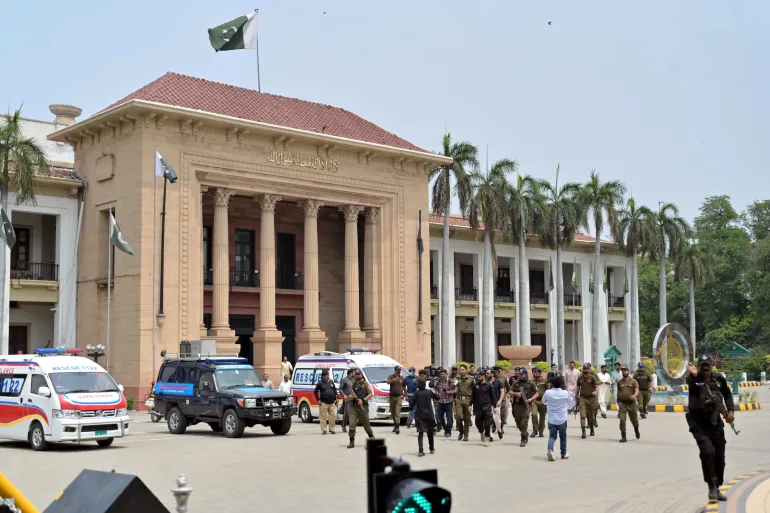
Legislators in Pakistan’s Punjab province have enacted the Anti-Terrorism (Punjab Amendment) Bill 2026, a controversial piece of legislation that permits the use of secret trials for terrorism-related offenses. The bill was passed by the Punjab Assembly on August 31 following a walkout by opposition members who voiced strong objections to the measure. This legislative move, which occurred despite earlier government indications that the bill would undergo further review by the law department or a parliamentary committee, has sparked intense debate among legal experts, rights advocates, and political analysts.
At the heart of the new law is the appointment of an unnamed senior bureaucrat, referred to as a “designated authority,” who holds the power to classify any terrorism case or entire categories of cases as “special security cases.” This designation is triggered if the official determines that the individuals involved require special protection. Once a case is labeled as such, the identity of the presiding judge, the prosecutor, police officers, witnesses, and even defense counsel must remain strictly confidential. Under these provisions, official titles replace names, and court orders are issued without revealing the identity of the signatory.
The procedural secrecy extends to the trial records, which are to be sealed and held jointly by the chief justice of the Lahore High Court and the designated authority. Furthermore, the law allows for hearings to be conducted via videolink—potentially from within prison facilities—utilizing voice-altering technology to protect the identities of participants. Witnesses will be identified solely through codes, and the legislation includes a broad clause permitting the government to implement “such other measures as it may deem appropriate,” effectively granting the executive branch open-ended authority to expand these powers without further parliamentary oversight.
Critics, including the Human Rights Commission of Pakistan (HRCP), have warned that the law lacks clear definitions regarding when these extraordinary powers can be invoked. A spokesperson for the HRCP noted that the ambiguity creates significant potential for the abuse of power, suggesting it could be weaponized against political opponents, protesters, or ordinary citizens under the guise of national security. Constitutional lawyer Rida Hosain argued that the introduction of “faceless courts” fundamentally undermines the ability of an accused person to challenge judicial bias or ensure impartiality, effectively stripping away essential safeguards of a fair trial.
Independent legislator Ahmer Rasheed Bhatti, who is affiliated with the party of jailed leader Imran Khan, described the law as a mechanism that creates a parallel judicial procedure. He argued that the executive branch, rather than the court, is effectively deciding the parameters of a fair trial. Bhatti drew parallels to the post-2014 era following the Peshawar Army Public School massacre, when military trials for civilians were introduced through a constitutional amendment that included a two-year sunset clause. In contrast, the current Punjab law contains no expiry date, meaning its survival will likely be determined by the judiciary rather than the assembly.
Government officials have defended the legislation as a necessary response to the rising threat of armed groups. Khalid Mahmood Ranjha, the legislator who introduced the bill, insisted that the process remains judicial in nature, noting that the chief justice of the Lahore High Court is responsible for assigning cases to sitting anti-terrorism judges. Ranjha dismissed concerns regarding political misuse as “propaganda” intended to politicize the issue, asserting that the law is strictly intended for “hardened terrorists.”
However, analysts point out that the government has not publicly identified a specific case or attack that served as the immediate trigger for this legislation. Furthermore, statistics show that Punjab accounts for a relatively small portion of Pakistan’s terrorism-related fatalities, with the vast majority occurring in the provinces of Khyber Pakhtunkhwa and Balochistan. Majid Nizami, a Lahore-based analyst, noted that while the 1997 anti-terrorism law appeared robust on paper, it was frequently utilized for political point-scoring over the decades. He added that he could not identify a single instance in the last ten years where witness intimidation had successfully derailed a prosecution in Punjab.
Legal experts like Mian Dawood argue that existing laws already provide sufficient mechanisms for protecting witnesses and conducting closed hearings. He contends that the new amendment shifts control from the judiciary to the executive, leaving citizens vulnerable to state overreach. As the debate continues, the lack of a sunset clause and the broad, undefined powers granted to the “designated authority” remain the primary points of contention, with many observers fearing that the “facelessness” of these proceedings may become the defining feature of the new legal landscape in Punjab. The report also notes that a person facing the country’s most serious criminal charge could be convicted without learning who heard the case against them, who prosecuted it or who testified, under the law. The report also notes that and the accused cannot contest being placed under this category, the law does not clearly define the parameters that need to be met. The report also notes that and the official picks one, a panel of five public prosecutors is drawn up. The report also notes that and why now, why is the government doing this. The report also notes that on the floor of the assembly, invoked Pakistan’s toll from terrorism over the past two decades to argue that the assembly was the right forum to strengthen prosecutions, speaker Malik Muhammad Ahmad Khan. The report also notes that “It is just an apprehension,” the politician said, calling the criticism “propaganda to politicise and make the law controversial”. The report also notes that which together account for more than 90 percent of the country’s terrorism deaths, the vast majority occur in Khyber Pakhtunkhwa and Balochistan.
Source: Al Jazeera