































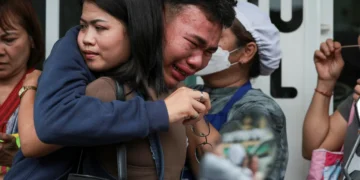








































On the morning of July 24, a barrage of three Russian missiles targeted Kyiv, overwhelming local air defenses. While one projectile was intercepted, the remaining two struck a sports facility, resulting in 12 deaths and over 100 injuries. Among the victims was Valentyna Savitska, a 32-year-old border security officer and mother of two. Her husband, Ihor Solovey, who leads the government’s Center for Strategic Communication, expressed the profound impact on their family, noting that their children, 15-year-old Vladyslav and 11-year-old Polyna, have been left to process the loss of their mother. Vladyslav has since expressed a desire to join the military, while Polyna continues to receive psychological support for the trauma.
The intensity of the conflict has reached new heights, with July marking the deadliest month for Ukraine since May 2022. Moscow deployed 376 missiles during the month, a significant increase from the 288 recorded in March and 192 in July 2025. This escalation also includes the use of nearly 5,000 drones and hundreds of guided bombs that have devastated residential areas. A notable attack on July 2 left 31 people dead and over 100 wounded after a missile struck near the apartment of 47-year-old Kateryna Babych, causing widespread destruction.
Analysts and officials attribute the rising casualty count to a severe deficit in Western-made missile interceptors. President Volodymyr Zelenskyy stated on August 12 that Ukraine currently possesses only one-tenth of the interceptors required to defend its territory. He suggested that if Washington provided even 5 to 10 percent of its current stockpile, Ukraine could secure its skies through the winter and neutralize incoming ballistic threats. Currently, the U.S. production of PAC-2 and PAC-3 interceptors at the Lockheed Martin facility in Arkansas is limited to approximately 50 units per month, with existing supplies being redirected to Middle East allies and domestic strategic reserves.
The logistical challenge of securing air defense is compounded by the need for trained crews to operate Patriot systems promised by the U.S. Lieutenant General Ihor Romanenko, former deputy head of Ukraine’s general staff, noted that while Kyiv is appealing to 40 nations for support, the acquisition process remains slow. Furthermore, Washington has declined to supply AIM-120 AMRAAM missiles, which would allow for the preemptive destruction of Russian ballistic capabilities at their source.
Meanwhile, Russia has ramped up its domestic production, with manufacturing plants operating in shifts to produce up to 300 missiles monthly. Volodymyr Fesenko, head of the Penta think tank, suggests these attacks are intended to foster an illusion of imminent victory for Vladimir Putin. This strategic imbalance has effectively stalled potential peace negotiations, as Putin continues to reject calls for a ceasefire.
The conflict has also extended to the maritime domain, with Russian strikes targeting Odesa and other ports, disrupting the export of grain, vegetable oil, and steel. In retaliation, Ukraine has targeted Russian oil terminals and cargo ships in Novorossiysk and occupied ports on the Sea of Azov. This mutual blockade, exacerbated by global weather patterns, contributed to a 30 percent increase in wheat prices by early August. Experts like Nikolay Mitrokhin of Bremen University note that the disruption of exports primarily impacts nations in the Middle East, such as Egypt, Lebanon, and Sudan, while Moscow remains largely indifferent to the economic strain on its own agricultural sector. The report also notes that earth-shattering strikes wounded more than 100 people and killed 12, including Valentyna Savitska, a fair-haired, 32-year-old border security officer and mother of two, the ear-popping. The report also notes that his son Vladyslav, 15, is now determined to join the military as “his choice is revenge, revenge for mum,” said Solovey, who heads the government-run Center for Strategic Communication that analyses and refutes Russian disinformation. The report also notes that his daughter Polyna, 11, is still recuperating. The report also notes that “Mum is unconditional love, mum is tenderness, mum is support. The report also notes that and [Polyna] already understands that she lost it all,” Solovey said. The report also notes that “Her psychologist says there’s a delayed stress, a scar for life.”. The report also notes that russia also sent nearly 5,000 long- and short-range drones and hundreds of gliding guided bombs that collapsed entire buildings in front-line areas. The report also notes that survivors often lose their houses and belongings.
Source: Aljazeera