




































































A new /YouGov survey reveals that while a majority of Americans continue to view the free market as a positive force, the nation’s ongoing economic dissatisfaction is driving many to question established systems. Conducted between August 12 and 14, 2026, the poll of 2,287 U.S. adults indicates that many citizens are increasingly open to solutions that fall outside traditional ideological boundaries.
The data shows that capitalism remains more popular than socialism among the general public, which holds a net-negative view of the latter. However, these labels are often interpreted in varied ways. When asked to define socialism, the most common responses focused on government control or ownership. Conversely, many participants associated the term with outcomes like equality, fairness, and social support. Republicans and independents were more likely to cite government intervention, while Democrats frequently pointed to public services and fairness.
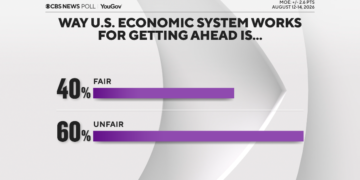
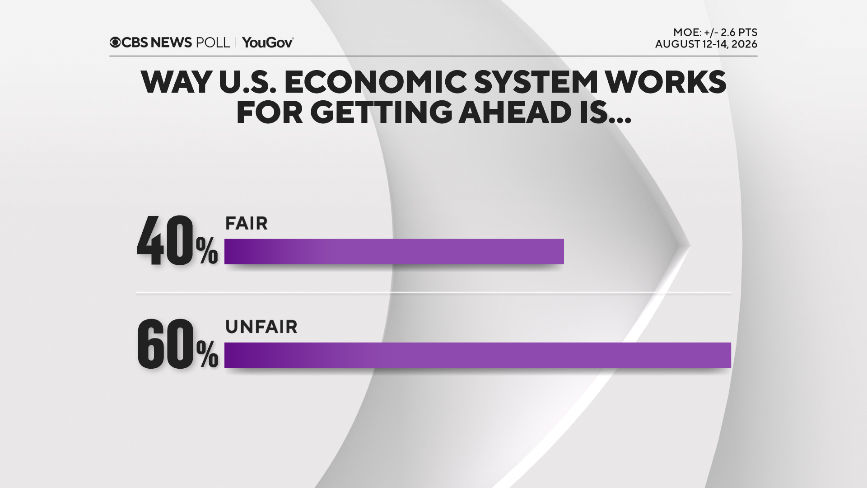
Economic anxiety serves as a significant backdrop to these political shifts. Most Americans report that achieving financial milestones—such as purchasing a home or raising a family—has become more difficult compared to the previous generation. This sentiment is particularly acute among younger citizens, who are more likely to perceive a lack of opportunity. Consequently, a majority of the public views the current U.S. economic system as fundamentally unfair regarding the prospects for advancement.
Within the Democratic Party, these economic frustrations have influenced internal dynamics. Unlike the broader public, rank-and-file Democrats hold a more favorable view of socialism than capitalism. This preference is especially pronounced among younger, white, and college-educated Democrats. For these voters, socialism is often seen as a pathway to improved personal finances, while capitalism is viewed as a detriment to their economic well-being.
The survey also highlights a divide regarding the party’s direction. Roughly half of Democrats believe the party is sufficiently progressive, while the other half argues it does not go far enough. Those in the latter group, who tend to be more liberal, are more likely to view socialism positively and express skepticism toward the party’s effectiveness. Interestingly, the term “Democratic establishment” does not carry significant negativity, with most party members viewing it neutrally or positively.
When it comes to policy, Democratic voters show a clear preference for bold, systemic changes over incremental adjustments, even if the latter are more achievable. They prioritize feeling that the party is actively fighting on their behalf. Despite this, the party faces challenges in aligning with voters on cultural and economic issues; currently, just over half of the electorate agrees with the Democrats on these fronts at least to some degree.
The Republican Party faces its own set of challenges. While it maintains a strong voice in support of capitalism, a slight majority of voters—including many Democrats and independents—express openness to government-imposed price controls. Furthermore, while most voters describe the Democratic Party as weak and ineffective, the Republican Party is frequently characterized as extreme and similarly ineffective.
The current political climate has also fostered a desire for generational change. Recent primary contests have seen incumbents defeated by younger challengers, a trend that resonates with the public. A significant portion of Americans, particularly Democrats, believe that having more young people in office would improve the political landscape. There is also a notable appetite for more moderate voices in government.
The survey results were weighted to ensure a representative sample based on gender, age, race, education, and 2024 presidential voting patterns, as reported by the U.S. Census American Community Survey and Current Population Survey. The margin of error for the study is ±2.6 percentage points. The report also notes that right now they say it’s harder now to do things like buy a house, raise a family, and to just feel financially secure than for the last generation, but those ideas aside. The report also notes that younger people are especially apt to feel opportunities are fewer. The report also notes that economic system unfair, in terms of the way it works for chances to get ahead. The report also notes that and appears to have many questioning the broader system – or at least eyeing solutions unconstrained by the usual ideologies, it’s all set against a years-long backdrop of Americans’ bad ratings of the economy. The report also notes that (Though many have no opinion of either.). The report also notes that though, can mean many different things, labels of systems. The report also notes that fairness, and generally the idea of helping people, but behind that were responses more related to views of an outcome than a process: equality. The report also notes that in particular, Democrats feel socialism would make their own finances better and that on balance, capitalism makes them worse.
Source: CBS News