








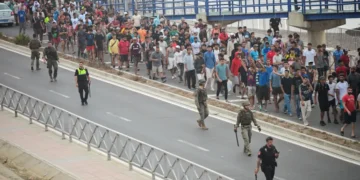





















































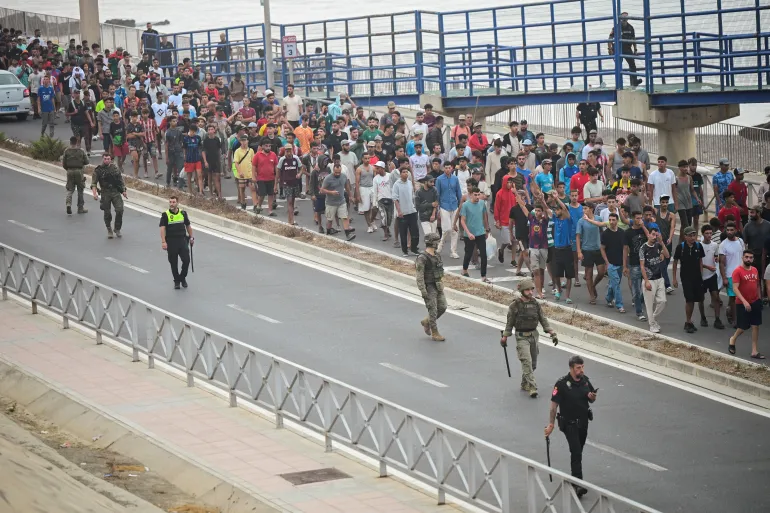
Hundreds of unaccompanied minors remain stranded in the Spanish territory of Ceuta, North Africa, following a massive influx of migrants who reached the area by swimming around the border fence with Morocco. While tens of thousands of people crossed into the territory last Thursday, an estimated 3,000 to 5,000 have managed to avoid expulsion. Among those remaining, more than 800 are unaccompanied minors facing an increasingly precarious future.
The situation has left many children traumatized, particularly those who witnessed family members perish in the Mediterranean Sea during the journey. A 17-year-old girl from Tangier recounted to the Associated Press that she was separated from her mother and witnessed Spanish police recovering the body of her eight-year-old brother from the water. “I saw people stepping on the dead,” she said through a translator. “Now we are children begging on the street.” Having found the local government youth facility at full capacity, she is currently dependent on the charity of local residents for basic food and shelter.
Spain’s 2000 law on foreigners’ rights, specifically Article 35, mandates that authorities provide “immediate attention” and protection to any unaccompanied minors identified by police. Despite these legal obligations, the city’s primary migrant center, which is designed to hold only 600 people, is completely overwhelmed. Reports from the Associated Press and AFP indicate that food is increasingly scarce, with many migrants forced to sleep outdoors, on beaches, or in the hills surrounding the city.
The broader migrant population includes individuals from various nations, such as Sudanese fleeing conflict, Palestinians from Gaza, Afghans, and citizens from several African countries. While most Moroccan adults who arrived last week have either returned home voluntarily or were pushed back by Spanish security forces, the legal path for others remains difficult. Adult migrants may apply for asylum, but the threshold for humanitarian protection for Moroccans is exceptionally high, and those who are rejected face formal expulsion procedures.
Tensions remain high at the border. In one instance, an AP journalist observed Spanish soldiers attempting to repatriate a crying Moroccan boy, only to be stopped by local residents who intervened to confirm his status as a minor. Following this public pressure, the boy was transferred to the Spanish Civil Guard rather than being sent back across the border.
For those currently stranded in Ceuta, the future remains bleak. Many continue to camp in the open, looking out toward the hazy horizon where mainland Europe—their intended destination—lies across the sea.
An estimated 3,000 to 5,000 migrants, of the roughly 60,000 who arrived in Ceuta on Thursday, have avoided expulsion.
Source: Aljazeera