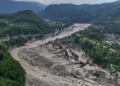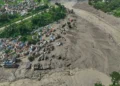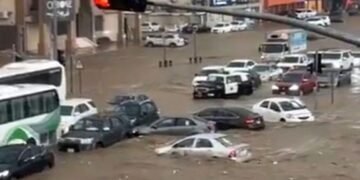










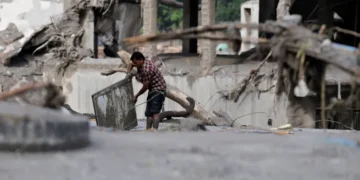






























































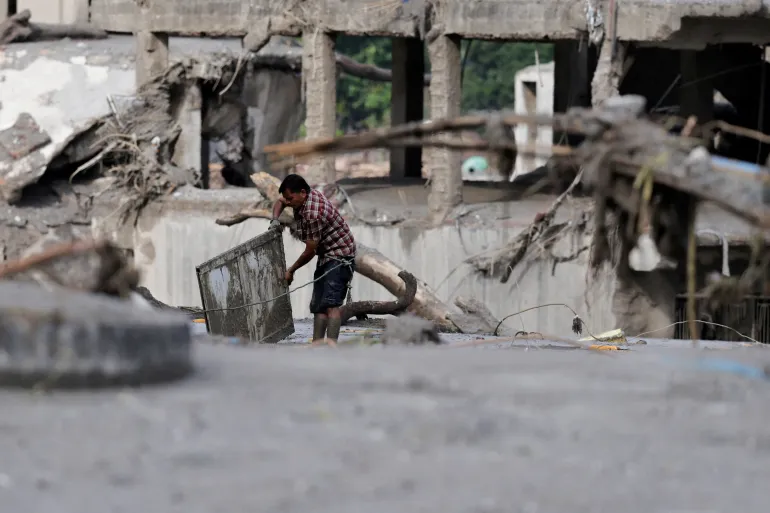
A massive collapse of rock and mud into a Himalayan river has triggered catastrophic flooding across Nepal and China’s Tibet region, leaving more than 1,400 people missing and at least 362 confirmed dead. Authorities report that 359 of the fatalities occurred in Nepal, while three people have died in Tibet. The disaster has devastated local valleys, sweeping away homes, vehicles, and critical infrastructure.
Chinese Premier Li Qiang arrived at the mudslide site in Tibet on Thursday to oversee emergency rescue and relief efforts. Meanwhile, in Nepal, more than 500 foreign nationals are among the 910 people currently reported missing. The list of missing tourists includes 177 individuals from India, 63 from the United States, 34 from Australia, 33 from the United Kingdom, and 25 from Canada. Additionally, Beijing’s foreign ministry confirmed that nearly 100 Chinese nationals are missing in Nepal.
In Tibet’s Gyirong county, officials report 558 people missing, a figure that includes 260 foreign nationals. Search operations are described as a massive challenge, as extensive damage to roads and bridges has made it difficult for rescue teams to reach affected areas. Helicopters have been deployed to transport survivors to hospitals, where many are being treated for injuries including skin burns and broken ribcages.
Nepal’s disaster authority has warned that a new lake formed at the site of the floods is currently rising and poses a significant risk of bursting. Army spokesperson Raja Ram Basnet confirmed that over 5,000 police and military personnel are involved in the response, using helicopters to drop food, medicine, and tents into the most isolated districts. India has also assisted by evacuating thousands of residents from border states like Bihar, Uttar Pradesh, and Uttarakhand due to threats to the Gandak River Basin.
While initial reports from local officials suggested an earthquake triggered the disaster, the US Geological Survey clarified that the seismic activity was actually the energy generated by the sudden collapse of glacial rock and ice. Satellite imagery from Planet Labs indicates the debris-laden surge originated along the Lhende River, roughly 20 kilometres northeast of the Rasuwagadhi border crossing.
Many of those caught in the disaster were pilgrims traveling to high-altitude sites such as Mount Kailash and Lake Mansarovar. Healthcare worker Tula Bahadur BK, based in Rasuwa, described the scene as total devastation, noting that riverfront settlements were completely swept away. Nepalese Prime Minister Balendra Shah has traveled to the Nuwakot district to assess the damage firsthand.
International support is mobilizing to assist the recovery. The United Nations Office for the Coordination of Humanitarian Affairs, led by Tom Fletcher, has allocated $2 million from the Global Emergency Fund. The US Department of State is providing $500,000 in aid and dispatching a disaster response adviser, while Canadian Prime Minister Mark Carney and Australian Prime Minister Anthony Albanese have both expressed concern over the difficulty of gathering information in such remote, resource-limited terrain.
Climate and public policy specialist Sunil Acharya warned that the tragedy highlights Nepal’s extreme vulnerability to climate hazards. He described the event as a brutal example of the climate crisis, emphasizing that the nation lacks the resources to manage such disasters independently. Acharya urged for greater international cooperation to limit greenhouse gas emissions to prevent further catastrophic damage in the future. The report also notes that and more than 1,400 people are missing across Nepal and China’s Tibet region after a huge collapse of mud and rock into a Himalayan river triggered catastrophic flooding across local towns and valleys, authorities have said, some 360 bodies have been recovered. The report also notes that a mix of government and private helicopters have “been drafted to fly into the areas to try to bring as many survivors as possible” to hospitals to receive treatment for injuries that doctors say include broken ribcages and skin burns, said Fernandez. The report also notes that rescuers in Nepal have deployed helicopters to search for survivors and drop emergency supplies to thousands of people cut off in a rugged mountainous area popular with trekkers and pilgrims travelling between Lhasa in Tibet and Kathmandu. The report also notes that verified by news agencies, showed rapid torrents of water and debris sweeping away dozens of people at a border crossing in Gyirong, while downstream in Nepal, homes, roads, and power infrastructure were destroyed, video footage from Wednesday. The report also notes that however, the US Geological Survey noted that the seismic event, initially recorded as a magnitude 4.4 earthquake, was actually the seismic energy generated by the sudden collapse of glacial rock and ice, followed by a huge debris flow. The report also notes that approximately 20 kilometres (12 miles) northeast of the Rasuwagadhi border crossing between Nepal and China, preliminary satellite imagery analysis by Planet Labs indicated that a landslide of ice and rock triggered a debris-laden surge down the Lhende River. The report also notes that thick mud swathed homes, trees, and vehicles, while aerial footage showed collapsed houses, submerged cars, and a metallic bridge washed away by the torrents, in the affected valleys.
Source: Al Jazeera