













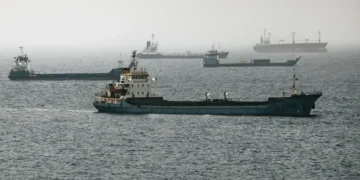



























































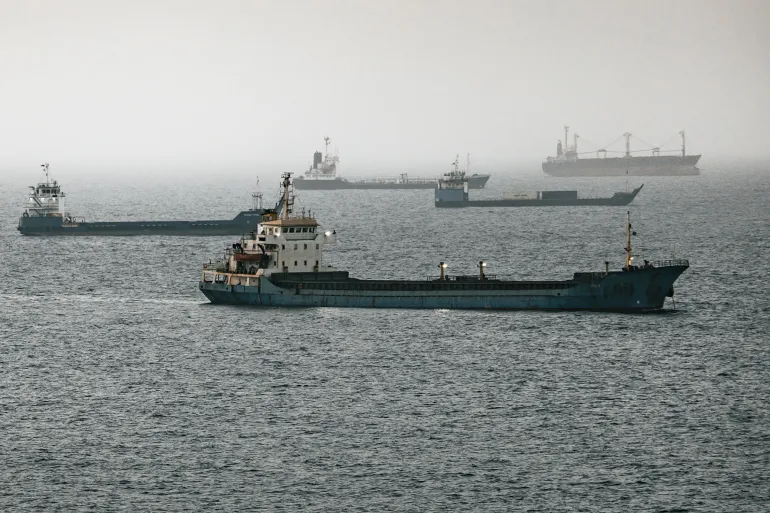
US President Donald Trump recently announced that the US Navy has successfully removed or detonated all sea mines within the Strait of Hormuz. This critical maritime corridor, which facilitates the transport of approximately one-fifth of the world’s oil and natural gas, had been effectively shuttered by Iran following the onset of hostilities between Tehran, the US, and Israel nearly six months ago. In a statement posted to his Truth Social platform on Tuesday, Trump warned that Iran has been formally notified that any vessel attempting to deploy new mines would be subject to immediate and systematic destruction.
However, Tehran has pushed back against these claims. On Wednesday, Iranian Deputy Foreign Minister Kazem Gharibabadi dismissed the US announcement as a tactical move intended solely to stabilize global markets. Gharibabadi asserted that the strait remains closed, noting that only Iran possesses knowledge regarding the actual placement of the mines. He further cautioned that any US mine-detection vessels entering the region would be treated as legitimate military targets.
The current impasse persists despite a recent agreement between Iran and Oman to establish a temporary transit route and initiate a joint project to clear the waterway. Before the conflict, the strait saw an average of 130 ships pass through daily. Today, the economic impact is severe; a July report from S&P Global indicated that war-risk insurance premiums for vessels traversing the area have surged from 1–3 percent to as high as 7.5–10 percent of a ship’s hull value.
The threat of mining emerged shortly after the war began in late February, when Iran’s National Defence Council declared that any attacks on Iranian territory would trigger the mining of the strait. By May 30, Oman’s Maritime Security Centre had issued warnings after a suspected floating mine was spotted. Shortly thereafter, US Secretary of State Marco Rubio informed the Senate Foreign Relations Committee that Iran had mined significant portions of international waters in the area. By June 11, the German navy, citing intelligence from US and British counterparts, reported mines at four distinct locations.
Maritime analysts suggest that while the US military has likely cleared primary shipping lanes, the risk has not been eliminated. Experts from the Foreign Policy Research Institute note that sea mines are a low-cost, high-disruption weapon; the mere suspicion of a single mine is often enough to halt commercial traffic. Estimates from the Philadelphia-based institute and RAND Corporation suggest Iran maintains a stockpile of between 2,000 and 6,000 mines, ranging from traditional tethered contact mines to sophisticated bottom-dwelling sensors.
Mark Hilborne, a senior lecturer in war studies at King’s College London, expressed a degree of confidence in the US assessment, noting that CENTCOM has utilized advanced underwater drones and space-based surveillance to identify and neutralize threats. However, he emphasized that clearing the main lanes is not equivalent to a total de-mining of the region. The Joint Maritime Information Center echoed this caution on Tuesday, warning that drifting or uncharted mines continue to pose a significant danger.
Beyond the physical threat of mines, analysts argue that the broader security environment remains precarious. Experts like Hilborne and others point out that drones, as well as anti-ship cruise and ballistic missiles launched from the Iranian mainland, represent a more persistent danger to shipping than mines alone. With no ceasefire in sight and the US implementing what it terms an “economic D-Day” of sanctions, the potential for renewed open conflict remains high.
To mitigate these risks, shipping companies are increasingly turning to alternative logistics. Industry analyst Almeida noted that the UAE has successfully implemented a shuttle service that helps offload insurance burdens from shippers, while Saudi Arabia is expanding ship-to-ship transfer operations and government-backed insurance schemes. These workarounds are creating a complex dilemma for Iran, as the country faces mounting economic pressure that some observers believe is now more acute than the pressure being applied to the US.
Ultimately, the consensus among maritime security experts is that the Strait of Hormuz will remain a high-risk zone as long as the underlying geopolitical conflict remains unresolved. While shipping lanes may be temporarily clear, the combination of potential hidden mines, the threat of missile strikes, and the lack of a diplomatic resolution ensures that the waterway remains a flashpoint for global trade. The report also notes that but that does not mean Hormuz is necessarily completely mine-free – or that commercial shipping can safely return to pre-war levels. The report also notes that that uncertainty carries a major cost. The report also notes that for a while, it remained unclear whether Tehran was bluffing. The report also notes that although Iran has never outright confirmed this, but evidence soon emerged that mines had been deployed. The report also notes that then, in a June 11 notice, Germany’s navy, citing information received from the US and British navies, said mines had been reported at four locations around the strait, although it could not verify their positions. The report also notes that iran has “the classic spiky balls that everyone envisions”, Savitz said, which are mines tethered to an anchor that explode when struck by a ship.
Source: Al Jazeera