




































































Emergency response teams are conducting intensive search operations along the Nepal-China border following a catastrophic glacial collapse that unleashed deadly flash floods and mudslides. The disaster, which struck on Wednesday, has left hundreds of people missing, including a significant number of foreign nationals.
Hikmat Singh Ayer, CEO and senior director of the Nepal Tourism Board, confirmed on Thursday that at least 65 U.S. citizens are among those unaccounted for in the region. This figure represents a sharp increase from the previous day’s estimates. Authorities in Nepal report that the total number of missing individuals within the country has reached 644, a group that includes 127 Nepalese nationals.
The human toll of the disaster continues to climb, with Nepal Police confirming that the death toll from the flooding and subsequent mudslides rose to 270 by Thursday. Search efforts are currently concentrated in the heavily impacted districts of Nuwakot and Rasuwa. Meanwhile, across the border in Tibet, Chinese state broadcaster CCTV reported that 558 people are missing, including 260 foreign nationals. Chinese authorities have confirmed at least three deaths in the area and noted that two villagers were successfully rescued.
The U.S. government has mobilized to assist in the aftermath. Secretary of State Marco Rubio stated that the department is prepared to provide humanitarian aid to the Nepali government. The U.S. Embassy in Nepal has issued a call for American citizens in the affected areas to reach out to their families, tour operators, or hotels, though they acknowledged that regional communications remain severely compromised. To support the ongoing response, the State Department is deploying an adviser to the region and has authorized a $500,000 grant for Catholic Relief Services.
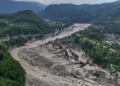
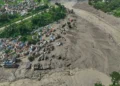
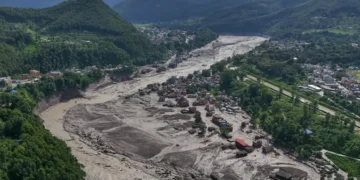
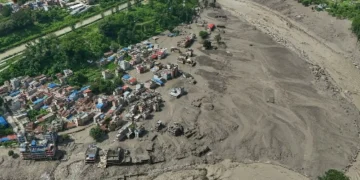
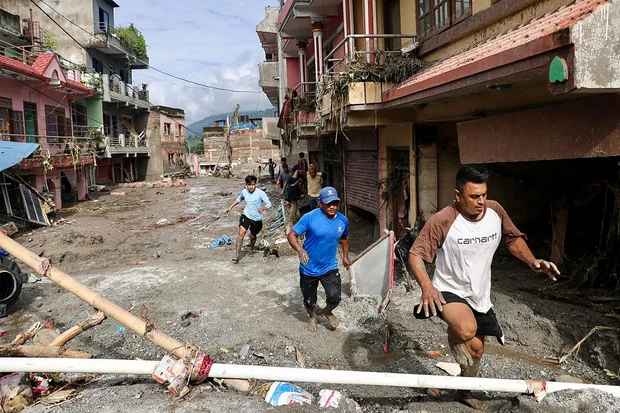
The scale of the destruction is immense, with torrents of water and debris obliterating critical infrastructure, including roads, bridges, power plants, and residential buildings. Drone footage from Wednesday revealed scenes of devastation, with entire villages buried under thick, cement-colored mud. In the Nuwakot district, survivors described the sudden onset of the flood, noting that the water arrived with such speed that residents had almost no time to evacuate.
The Nepalese army has been instrumental in rescue efforts, deploying helicopters to extract more than 100 people from isolated areas on Thursday. Brigadier General Raja Ram Basnet, the army spokesperson, confirmed that eight foreign nationals were among those airlifted to Kathmandu. Additional rescue teams have recovered bodies as far as 62 miles downstream in the Chitwan district, while numerous injured individuals have been transported to the capital for urgent medical treatment.
In Tibet, the situation remains precarious near the Gyirong Port, where mudslides have left debris depths exceeding five to six feet in some sections. CCTV reported that all access roads to the port are damaged and communication lines are severed. Officials are also monitoring a newly formed barrier lake near the port that threatens to complicate rescue operations, prompting the deployment of military transport aircraft to the site.
While initial reports suggested a magnitude 4.4 earthquake had occurred, the U.S. Geological Survey later clarified that there was no seismic event. Instead, data from satellite imagery and seismic stations confirmed that the disaster was caused by a glacial collapse. Experts from the International Centre for Integrated Mountain Development noted that the flood wave was exceptional in both speed and magnitude, with water levels on the Trishuli River rising 27 feet in just 30 minutes.
The Lhende Khola river system, a tributary of the Bhotekoshi, was identified as the primary source of the surge. Saswata Sanyal, a disaster risk reduction specialist, noted that this specific river has flooded twice in the last 14 months, highlighting the increasing instability of the Himalayan ice system. Researchers in Kathmandu have previously warned that glaciers across the Hindu Kush Himalaya region are melting at double the rate observed since 2000, posing a persistent threat to water supplies and infrastructure in the region.
As the search continues, international figures have expressed their support for the victims. The Dalai Lama issued a statement on Thursday offering prayers and condolences to those affected by the tragedy in both Nepal and Tibet, acknowledging the profound loss of life and the widespread suffering caused by the disaster. The report also notes that the head of Nepal’s tourism board said Thursday that 65 U.S. The report also notes that solidarity Wednesday with the Nepali people, saying in a social media post that the department “stands ready to support the government of Nepal with needed humanitarian assistance. The report also notes that embassy in Nepal expressed “heartfelt condolences to the families and loved ones of those who lost their lives in the devastating floods” and said it was “working to account for U.S. The report also notes that tearing down bridges and dams and sweeping away buildings, videos broadcast by regional news outlets and posted on social media show violent torrents of water surging through valleys and mountain passes. The report also notes that the region’s steep valleys are economic lifelines and travel corridors but are precarious when disaster strikes. The report also notes that images showed what appeared to be the second floors of buildings in Nepal’s hard-hit Nuwakot district slathered in mud after the torrent rushed by.
Source: CBS News