








































































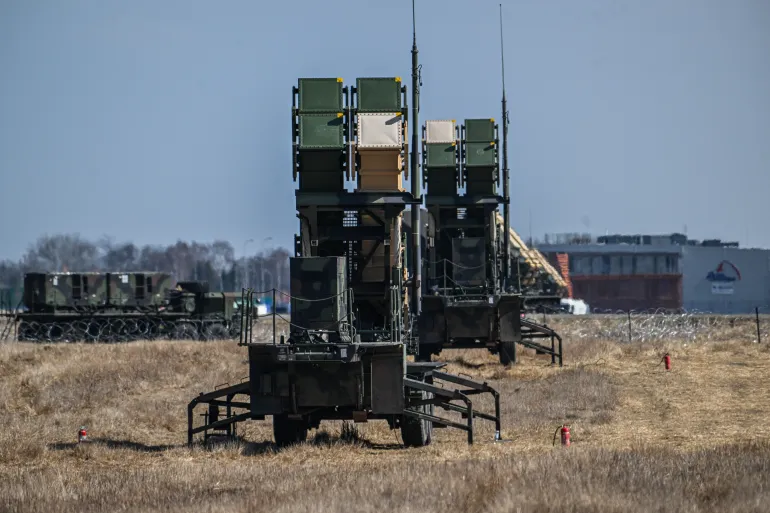
The White House and the Pentagon have formally pushed back against a series of media reports suggesting that US offensive and defensive weapon supplies have reached critical lows after five months of conflict with Iran. While experts have raised alarms that depleted stockpiles of air defense interceptors—specifically for Patriot and Terminal High Altitude Area Defense (THAAD) systems—could leave American forces and regional allies vulnerable, the administration maintains that its military readiness remains intact.
In a statement provided to Al Jazeera on Tuesday, President Donald Trump rejected claims of supply deficiencies. He asserted that the United States possesses a larger munitions arsenal than any other nation, despite what he described as the previous administration’s excessive transfers to Ukraine and Europe. Trump stated, “We have far more munitions than anyone in the world, and far more than we need,” while criticizing the Biden administration’s past policies. He added that as production ramps up, the US will resume supplying allies in Europe and elsewhere.
Pentagon spokesman Sean Parnell echoed this sentiment, emphasizing the military’s global superiority. “America’s military is the most powerful in the world and has everything it needs to execute at the time and place of the President’s choosing,” Parnell said. He noted that the military has successfully conducted operations across various combatant commands while maintaining a deep arsenal to protect national interests.
These official assurances contrast with several reports from earlier this week. CNN, for instance, cited sources claiming the military had exhausted 80 percent of its pre-war THAAD interceptors and approximately half of its Patriot supply, labeling these levels as “dangerously low.” Secretary of Defense Pete Hegseth publicly contested these figures on X, dismissing the reports as untrue.
Independent analysis from the Center for Strategic and International Studies (CSIS) CSIS assessed that even with recent funding surges, it would take at least three years to restore these stockpiles to pre-war levels. Furthermore, Reuters and CBS News reported that the majority of Army Tactical Missile Systems (ATACMS) and Precision Strike Missiles (PrSM) have been utilized, with sources suggesting that nearly all of these $1 million offensive missiles have been deployed.
Despite these reports, the Trump administration has not publicly acknowledged any supply threats, even while requesting $95 billion in the Fiscal Year 2027 defense budget and an additional $21 billion in supplemental funding to replenish stores. Reports indicate that Chairman of the Joint Chiefs of Staff Dan Caine has raised concerns internally, and The New York Times reported that supply worries influenced the President’s decision to avoid further escalation in July following the collapse of a June memorandum of understanding with Tehran.
Mark Cancian, a retired US Marine Corps colonel and senior adviser at CSIS, warned that shortages in offensive weapons like ATACMS and PrSM force the military to rely on riskier alternatives. He explained that if these long-range missiles are unavailable, the military must resort to air-delivered or sea-delivered strikes using JASSM or Tomahawk missiles, or send aircraft directly into enemy territory, which increases danger to personnel.
Cancian described the shortage of air defense interceptors as a significantly more serious issue. “When we talk about missile defense… we don’t have that many left, and there are no good substitutes,” he noted. “If we run out of Patriots, then the missiles get through.” This vulnerability was highlighted by the July 17 attack on the Muwaffaq Salti airbase in Jordan, where three US soldiers were killed after Iranian missiles bypassed existing defenses.
While the exact extent of Iran’s remaining military capability is unclear, Cancian assessed that Tehran is unlikely to fully exhaust US interceptors in the immediate future. However, he cautioned that every interception currently depletes resources intended to deter other powers, such as China. “Every missile that’s used is one fewer that’s available to deter China, and we are now at a point where the joint staff are really very nervous about that,” he said.
In response to these constraints, reports from NBC News and other outlets suggest the military has adopted a more selective approach to intercepting Iranian strikes that are deemed unlikely to cause significant damage. While this strategy preserves interceptors, experts warn it could increase the risk of miscalculation.
The potential for shortages also impacts Washington’s international commitments. In May, the Trump administration announced $25 billion in Patriot interceptor sales to Kuwait, Bahrain, the United Arab Emirates, and Qatar. Cancian noted that the US will likely prioritize replenishing its own stocks before fulfilling these foreign obligations, stating, “That will almost certainly change, and the US will endeavour to hold more of the interceptor back to replenish our own stockpiles.”
On Wednesday, Ukrainian President Volodymyr Zelenskyy noted that allies have provided significantly fewer air defense interceptors to Kyiv in 2026, delivering only one-third of the volume supplied during the same period last year. Regarding the timeline for US recovery, Cancian emphasized that while funding is available, the primary obstacle remains the time required for production. “Money will not be a problem,” he stated. “The problem is time.”
Secretary of Defense Pete Hegseth swiftly contested the 80 percent figure and the characterisation of the threat it posed, posting “not true” and “shame on you” on X on Monday.
In an analysis published by the Washington, DC-based Center for Strategic and International Studies (CSIS) on July 27, the think tank calculated that, as of that date, the military had just more than a third of its Patri
No Trump administration official has publicly acknowledged any threats posed by munition shortages, despite the fact the administration has requested $95bn in its Fiscal Year 2027 defence budget and $21bn in a supplement
Trump pointed to new efforts to scale up weapons production, although experts have questioned whether supplies of air defence missiles could indeed be scaled up in a timely fashion.
In an analysis published by the Washington, DC-based Center for Strategic and International Studies (CSIS) on July 27, the think tank calculated that, as of that date, the military had just more than a third of its Patriot interceptors left and about half of its THAAD interceptors.
That came after a memorandum of understanding (MoU) between Washington and Tehran that had brought a halt to fighting in June collapsed, leading to nearly two weeks of attacks from both sides.
“It’s more dangerous, and you really have to beat down any air defence system,” he added.
There have already been reported delays in offensive weapons deliveries to US allies in Europe and Asia, although no air defence delays have yet been reported to allies in the Middle East.
He has repeatedly sought US approval to produce the weapons in Ukraine, a permission only Japan and Germany currently have.
Source: Aljazeera