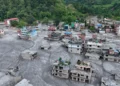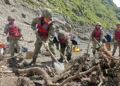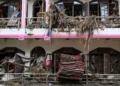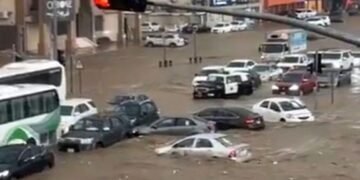










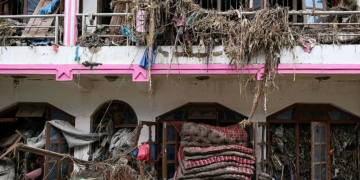

























































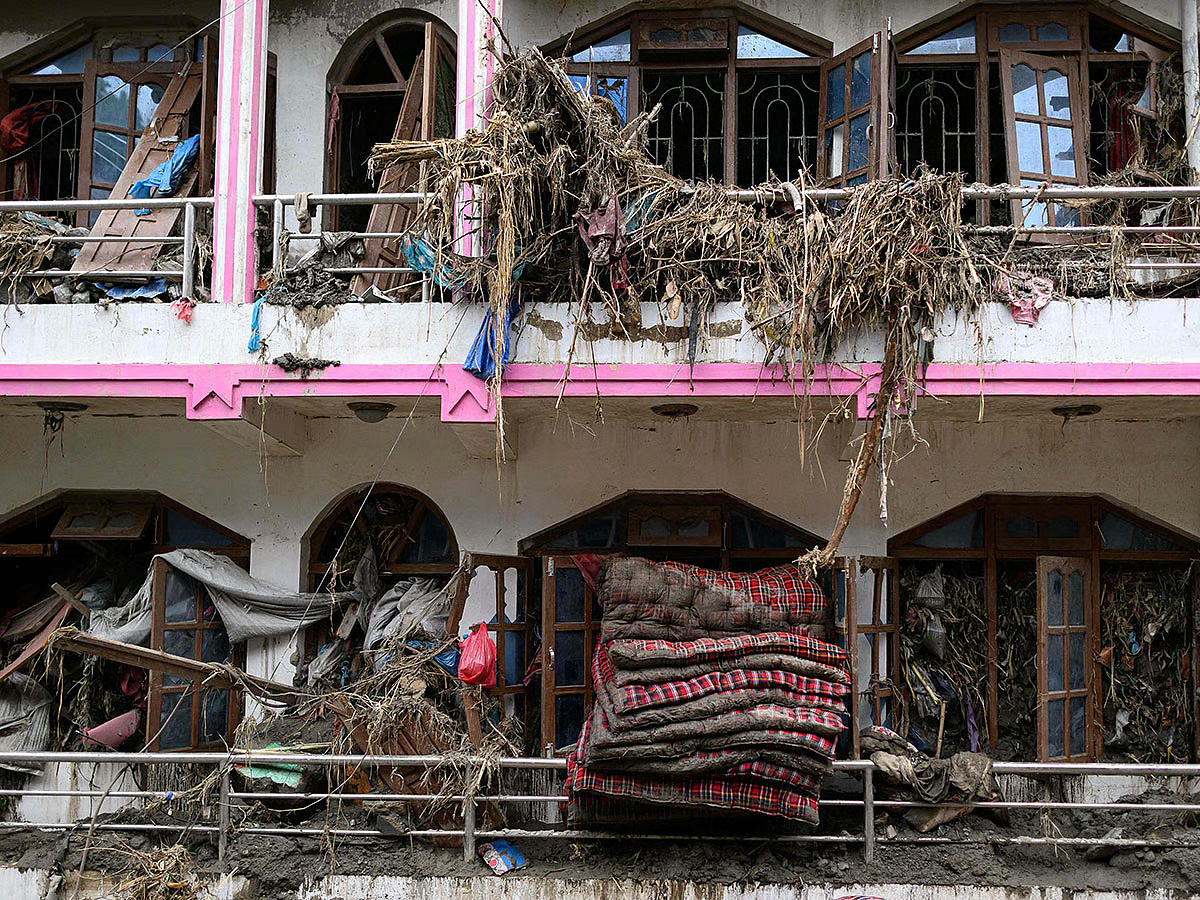
The death toll from the catastrophic flooding that devastated the border region between Nepal and Tibet has climbed to 691, with nearly 3,000 people still unaccounted for as of Sunday. Rescuers are currently navigating deep, unstable mud in a desperate search for survivors across the affected Himalayan landscape.
Official figures from both Nepal and Chinese authorities in Tibet confirm the scale of the crisis. Nepal has reported 2,426 individuals out of contact, a figure that includes hundreds of foreign nationals. Meanwhile, China’s state broadcaster, CCTV, stated that 546 people remain missing in the Tibetan region, with 16 confirmed deaths, including 261 foreign citizens among the missing.
A significant portion of the missing—estimated at 933—are workers from various hydropower projects situated along the rivers where the torrent of icy debris descended. More than 100 of these workers are believed to be trapped inside multiple hydropower tunnels. In a critical rescue effort late Saturday, the Nepali army successfully inserted a pipe into a tunnel at the Trishuli 3A hydroelectric site, “sending air through the small opening,” according to Home Minister Sudan Gurung.
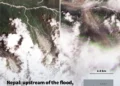
International support has begun to arrive, with India deploying an 11-person specialized team and China sending a nine-person tunnel rescue unit. The disaster, which is believed to have been triggered by a glacial collapse, has prompted India to increase monitoring of its own Himalayan glaciers and lakes in Uttarakhand, as noted by state disaster management minister Madan Kaushik.
The economic impact of the disaster is expected to be severe. Foreign Minister Shisir Khanal indicated that reconstruction costs could reach “billions of dollars,” noting that the government plans to conduct a thorough loss and damage assessment while appealing to the international community for support. The Red Cross estimates that as many as 93,000 people in Nepal have been affected by the flooding.
In the town of Bidur, which serves as a primary rescue hub, families are gathering at an army base to check lists of survivors. For many, the wait remains agonizing; Kalka Sharda, who traveled to the base searching for her son, a laborer at a local plant, expressed frustration that authorities have yet to provide clear information regarding the missing.
Global aid efforts are mobilizing to assist the region. The United States and Canada have each pledged approximately $3.6 million in humanitarian assistance, while the UK has offered $6.8 million. The United Nations has released $2.5 million in emergency funding, the European Union has promised $2.3 million, and the International Federation of Red Cross and Red Crescent Societies has allocated over $1 million as part of a $31 million emergency appeal. Chinese President Xi Jinping also extended an offer of assistance from Beijing on Friday.
Nepal has specifically requested international aid in the form of heavy-lift drones, DNA testing kits, and specialized body freezer storage units to manage the aftermath of the tragedy. While the region remains difficult to access—particularly the Tibetan side, which is largely closed to independent journalists—the search and recovery operations continue under extreme conditions. The report also notes that figures from Nepal and from Chinese authorities in charge of Tibet put the total number of missing close to 3,000, with 691 bodies recovered. The report also notes that india, which has extensive experience in such rescues, has sent an 11-person specialised team. The report also notes that i have come here looking for my son,” said Kalka Sharda, scanning the list in desperation. The report also notes that but I can’t find his name, and the authorities are not saying anything, he was a labourer at the hydropower plant. The report also notes that as a neighbour, and also have a similar geographic situation, since we share a border with Nepal. The report also notes that nepal-China flood death toll rises to 682. The report also notes that over 2,400 still missing, nepal flood toll rises to 579.
Source: Gulf News