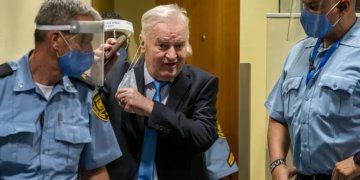


































































Ratko Mladic, the notorious military commander convicted of orchestrating the first genocide on European soil since World War II, has died in prison in The Hague at the age of 84. Mladic, widely referred to as the “Butcher of Bosnia,” was a central figure in the conflicts that followed the dissolution of Yugoslavia.
Earlier this year, Serbian authorities had petitioned for his release to receive medical treatment, claiming his health was “serious” and that he “required serious medical treatment.” However, the United Nations International Residual Mechanism for Criminal Tribunals maintained that he was receiving adequate care while in detention.
Mladic’s military career began in the Yugoslav People’s Army, where he rose through the ranks before being appointed commander of the Republika Srpska army in May 1992. Following Bosnia and Herzegovina’s declaration of independence, he led forces that sought to carve out a separate, contiguous Serb state, a goal that resulted in widespread devastation and the displacement of thousands.
The most significant of his crimes occurred in July 1995, when his forces seized the UN-designated “safe area” of Srebrenica. In the days that followed, more than 8,000 Bosniak men and boys were executed. While many victims were killed in and around the town, others were murdered while attempting to flee through nearby forests. International courts later confirmed these actions constituted genocide, and while many remains have been recovered from mass graves, the search for approximately 1,000 victims continues.
Beyond the Srebrenica genocide, Mladic was held responsible for the 44-month siege of Sarajevo, during which his forces utilized snipers and artillery to terrorize the civilian population. More than 11,500 people were killed during the siege, which remains one of the longest in modern history. He was also convicted for the hostage-taking of UN peacekeepers.
After the war, Mladic evaded capture for nearly 16 years. His eventual arrest in May 2011, at a relative’s home in the Serbian village of Lazarevo, was a critical milestone for Serbia’s international standing, as it was a prerequisite for closer ties with the European Union. He was subsequently transferred to The Hague, where he was sentenced to life imprisonment in 2017 for genocide, crimes against humanity, and war crimes.
Despite the finality of his convictions, Mladic remains a polarizing figure. In parts of Serbia and Bosnia and Herzegovina, he is still celebrated by some as a military hero, with murals depicting him visible in cities like Banja Luka and Belgrade. This glorification highlights the deep-seated political and social divisions that persist regarding the region’s wartime history.
The denial of these historical facts remains a significant issue. Data from the Srebrenica Memorial Centre indicates that 149 instances of public genocide denial were recorded in the first quarter of 2026, an increase from the 99 cases documented throughout 2025. In an effort to address this, the UN General Assembly passed a resolution in May 2024, designating July 11 as the International Day of Reflection and Commemoration of the 1995 Genocide in Srebrenica to preserve the memory of the victims and combat the revision of historical facts. The report also notes that about 40km (25 miles) south of Sarajevo, mladic was born in the village of Bozanovici near Kalinovik. The report also notes that following Slovenia and Croatia, Bosnian Serbs established their own political and military structures and proclaimed Republika Srpska, which controlled territory covering roughly half of Bosnia and Herzegovina at the time, when Bosnia and Herzegovina declared independence from Yugoslavia in the spring of 1992. The report also notes that however, his forces failed to achieve major territorial gains in several key areas. The report also notes that republika Srpska would formally become one of Bosnia and Herzegovina’s two entities under the 1995 Dayton Peace Agreement. The report also notes that mladic’s forces were involved in a large number of atrocities across Bosnia and Herzegovina. The report also notes that they shelled the city and used snipers against its residents, from positions on the surrounding hills.
Source: Al Jazeera