











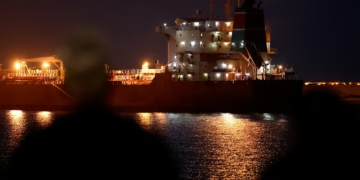
























































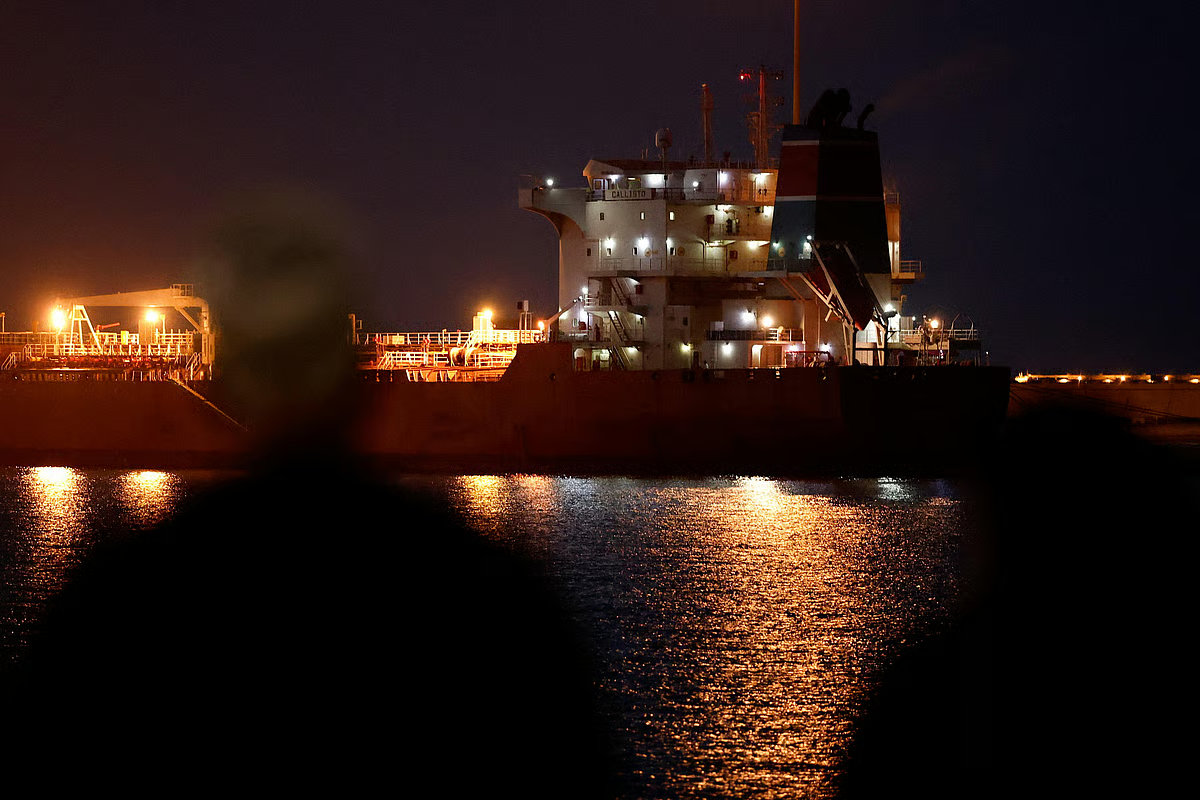
A significant shift is occurring in the Strait of Hormuz, where tankers carrying millions of barrels of Gulf crude are disappearing from public tracking systems as they navigate the world’s most critical oil chokepoint. These vessels are deliberately going dark, switching off their Automatic Identification System (AIS) transponders to transit the strait while remaining as close to the Omani coast as possible.
According to data from the shipping analytics firm Kpler, approximately 80 percent of traffic through the strait over the past two weeks has utilized this method. This invisible shipping operation, often supported by the US military, is designed to shield vessels from potential Iranian drone and missile attacks, ensuring that Gulf oil continues to reach global markets.
The process is illustrated by the journey of the Greek-owned supertanker Kiku. After departing Qatar’s Mesaieed terminal with a load of crude, the vessel crossed the strait and was positioned off Dubai on July 31 when its signal vanished. By 10 a.m. the following day, the Kiku reappeared on the opposite side of the strait, having completed a secure nighttime transit.
Key Shipping and Market Metrics
- Dark Traffic Share: 80% of Hormuz traffic estimated to have gone dark over the past two weeks.
- Daily Oil Flow: 8 to 9 million barrels per day estimated to pass through Hormuz, per the US Department of Energy.
- Protected Volume: Roughly 5 million barrels per day carried on US-protected routes during July.
- Vessel Assistance: Over 1,000 ships have been helped through the strait by US Central Command.
- Security Incidents: At least 15 ships using southern routes have been struck since early June, according to International Maritime Organization data.
- Inventory Impact: Global oil inventories have been depleted by as much as 1.9 billion barrels during the conflict.
There is a distinct irony in this strategy, as the tactics being used to protect Gulf oil—switching off transponders and utilizing ship-to-ship transfers—mirror the methods Iran has historically employed to bypass international sanctions. In this instance, however, the goal is to mitigate exposure to regional hostilities rather than evade economic restrictions.
The US military is heavily involved in maintaining this southern corridor, deploying warships, aircraft, and helicopters equipped with anti-drone and anti-missile technology. Despite these efforts, the protection is not absolute. At least 15 vessels using these southern routes have been hit since the beginning of June, and Iran maintains the capability to escalate its operations against shipping and energy infrastructure.
The use of dark transits has created a discrepancy between official tracking data and actual oil volumes. While conventional services relying on AIS data may underestimate flows, the US Department of Energy estimates that traffic through the strait has averaged between 8 million and 9 million barrels daily—nearly double what some market analysts previously suggested. Satellite and radar imagery have confirmed this, showing vessels physically present near the Omani coast that remained invisible on commercial tracking platforms.
This consistent flow of oil has been a critical factor in preventing a total supply shock. While the war has depleted global commercial inventories by approximately 1.9 billion barrels, producers have successfully circumvented a total shutdown of the strait. Saudi Arabia has diverted 5 million barrels per day through its East-West pipeline to Yanbu, while an additional 2 million barrels per day are being rerouted around the strait. Furthermore, increased production from Brazil, Guyana, Venezuela, and the United States has helped stabilize global prices.
Observers, including those at CNN, have documented over a dozen ship-to-ship transfers in the Gulf of Oman over a two-day period, with the cargo subsequently bound for markets in China, Taiwan, South Korea, the Philippines, Vietnam, and Thailand. While the US military continues to maintain a presence with roughly 20 warships in the Gulf of Oman, officials acknowledge that sustaining such a high level of deployment remains a significant operational challenge. The report also notes that the remarkable result is that a largely invisible shipping operation is helping keep Gulf oil flowing — and preventing an already severe energy crisis from sending crude prices dramatically higher. The report also notes that also Read: 1,300 commercial vessels transited Strait of Hormuz since May 2026: US CentCom. The report also notes that images from August 14 showed vessels around the Omani side of Hormuz that did not appear in MarineTraffic data at the same time — ships that were physically there but electronically invisible. The report also notes that in July, tankers using US-protected routes alone carried about 5 million barrels a day out of the Arabian Gulf, according to analysts cited by The New York Times. The report also notes that yet the feared complete shutdown of Hormuz has not materialised.
Important Details
- The report also notes that the oil market can’t see everything.
Source: Gulf News