












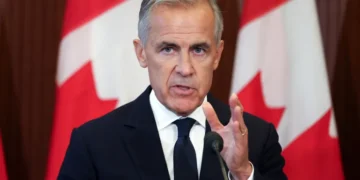


























































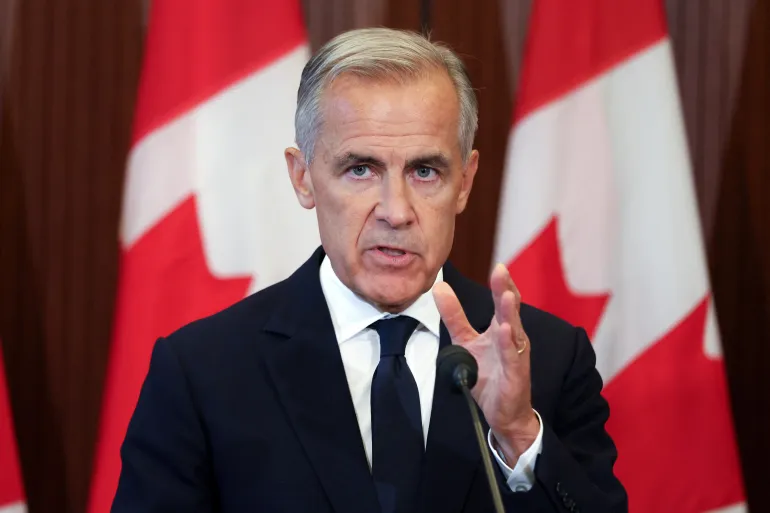
Canadian Prime Minister Mark Carney has announced that Canada will implement retaliatory, “dollar-for-dollar” tariffs against the United States. This decision follows the US government’s move to impose 50 percent tariffs on approximately $20 billion worth of Canadian products.
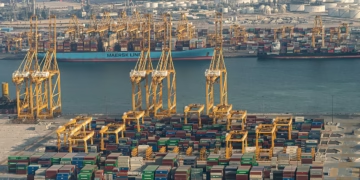
The Canadian response is scheduled to take effect on September 8 and will target a variety of US imports, including steel, dairy, electronics, paper, and agricultural equipment. Carney described the move as a “focused response” that his government is taking “reluctantly.”
The escalation follows months of trade friction between the two nations. On July 20, President Donald Trump introduced the 50 percent tariffs, citing what he termed “discriminatory treatment” in Canadian trade policies. While negotiators attempted to reach a compromise—even securing a temporary extension past a Wednesday deadline—talks ultimately collapsed after three days of intensive discussions.
Carney stated that Canada walked away from the negotiations because the US “asked too much and they offered too little.” He specifically pointed to last-minute American demands regarding automotive imports and restrictions on Canada’s ability to establish independent trade alliances with other nations as the primary reasons for the breakdown. “The US introduced in the last hours efforts to restrict our ability to have other trade deals,” Carney noted, adding that such terms were “uneconomic, unfair” and undermined the benefits of any potential agreement.
The Prime Minister emphasized that Canada had been “pragmatic, patient and persistent” throughout the process. However, he warned that the current US administration is prone to abrupt shifts in policy, remarking that “sometimes, its signature was written in pencil.”
Conversely, the Trump administration has placed the blame for the failed negotiations on Canada. US Trade Representative Jamieson Greer stated on Fox News that there are no further talks planned between the two countries. Greer asserted that the US had offered a favorable deal that Canada rejected, adding that the US would now move forward with measures to counter Canada’s retaliatory actions.
Despite the high-stakes trade dispute, Carney signaled that Canada would focus on long-term economic resilience. “We can’t control the storm that blows in from Washington,” he said. “We can, however, chart a new course by building Canada strong and diversifying our trading relationships abroad.”
When questioned about the aggressive nature of the response, Carney framed the situation as a defensive necessity. “You’re at war when you get attacked,” he said. “We got attacked.”
The ongoing tension marks a significant point of conflict between the two long-standing allies. Since returning to the White House in 2025, Trump has frequently utilized tariffs as leverage to reshape global commercial relationships. Carney, who has been at odds with the Trump administration since taking office, has previously advocated for “middle powers” to unite to counterbalance the influence of superpowers like the US and China.
As the September 8 deadline approaches, the prospect of a trade war between the two neighbors appears increasingly likely, with both sides signaling a hardening of their respective positions. The report also notes that just hours after the US imposed 50 percent tariffs on nearly $20bn worth of the country’s goods, carney addressed Canadians on Saturday. The report also notes that “We pursued every opportunity to reach an agreement that protects Canadian workers and their families, that strengthens our economy and that respects Canadian sovereignty,” Carney said. The report also notes that carney’s remarks come after weeks of uncertainty over whether the tariffs would take effect. The report also notes that since the start of his second term, Trump has sought to ratchet up pressure on Canada, as part of a push to increase US influence over the Western Hemisphere and advance US priorities. The report also notes that the two neighbours are longtime allies and have been among each other’s largest trading partners for decades. The report also notes that the revised tariff deadline expired at midnight Eastern US time (04:00 GMT). The report also notes that when reporters pressed him for specifics, Carney referred to 11th-hour changes regarding car imports, as well as restrictions on Canada’s ability to forge new trade alliances.
Source: Al Jazeera