




















































The ongoing standoff between the United States and Iran has entered a new, complex phase defined by political attrition rather than direct military confrontation. As the conflict reaches its fifth month, the central question has shifted from “Who will win the war?” to “Who will determine the terms for ending the war?” This transition reflects a mutual recognition that while military deterrence remains a factor, it is insufficient on its own to achieve long-term strategic objectives.
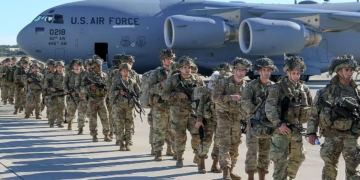
During the initial stages of the conflict, Washington’s primary goal was to degrade Iran’s military capabilities, including its missile and drone programs, air defense networks, and naval reach. While the U.S. has achieved significant tactical success in these areas, it has not compelled Tehran to fundamentally change its regional behavior. Conversely, Iran has sought to increase the costs of the conflict by targeting energy infrastructure and maritime navigation, yet it faces mounting economic and military pressure that makes an open-ended confrontation increasingly difficult to sustain.
Political attrition is characterized by a shift in objectives: both nations are now focused on undermining the other’s political will, economic resilience, and diplomatic standing. Rather than seeking a decisive battlefield victory, Washington and Tehran are maneuvering to shape the conditions under which any future settlement might be negotiated. This strategy integrates military pressure with economic sanctions and diplomatic maneuvering to maximize leverage.
This dynamic creates a seemingly contradictory environment where both sides exchange threats while simultaneously signaling an openness to dialogue. The Trump administration has indicated a willingness to pursue a new agreement if specific conditions are met. While Iranian officials publicly deny engaging in direct negotiations, they have not ruled out the use of indirect communication channels or mediation by regional third parties.
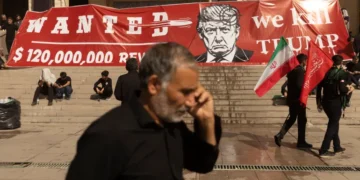
This duality is intentional, serving as a standard pattern in crisis management where media and military escalation are used as tools to improve a party’s standing at the negotiating table. Consequently, escalation and diplomacy are no longer viewed as mutually exclusive paths; they have become complementary instruments of a single strategy. Each side aims to exert maximum pressure while keeping the door open for a potential settlement.
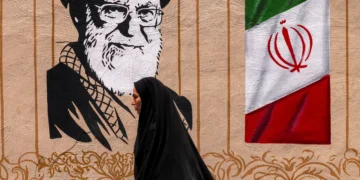
The evolution of U.S. strategy highlights this shift. The Trump administration is increasingly combining military power with comprehensive economic sanctions to financially isolate the Iranian regime. This approach allows Washington to intensify pressure without incurring the massive costs associated with a full-scale war. Iran, for its part, is attempting to demonstrate its capacity to endure these pressures, aiming to enter any future negotiations from a position of relative strength.
Regional actors are playing an increasingly vital role in this phase, acting as mediators to contain escalation and maintain communication lines. Because neither the U.S. nor Iran desires a total war, these third parties have become essential in preventing the conflict from spiraling out of control. However, this phase of political attrition does not necessarily equate to stability.
The current environment creates conditions for unpredictable and prolonged geostrategic competition. As long as both Washington and Tehran remain unwilling to offer substantial concessions, the conflict is likely to manifest through periodic crises, cyber operations, proxy activities, and calculated military incidents. In this sense, political attrition does not settle the conflict; it institutionalizes it.
The risks of this phase extend well beyond the primary combatants. Regional nations, particularly those reliant on stable maritime routes and energy exports, remain vulnerable to sudden escalations. Furthermore, global markets continue to react to both military developments and the political rhetoric emanating from both capitals. The absence of large-scale military operations should not be mistaken for peace, as the situation remains highly volatile.
A significant danger lies in the possibility that a single miscalculation, an unintended military incident, or a proxy-led escalation could undermine containment efforts and trigger a full-scale war. In the absence of a clear political framework, the threshold for error remains dangerously low. The conflict has effectively moved into a realm where political endurance and diplomatic influence are as critical as military deterrence.
Ultimately, the future of the standoff depends on how effectively Washington and Tehran manage the delicate balance between coercion and diplomacy. Whether this phase of attrition leads to a negotiated settlement or a renewed cycle of escalation remains an open question, as both sides continue to test the limits of their opponent’s resolve.
Sara Al Neyadi, a Senior Researcher at Trends Research and Advisory, notes that this transition reflects a broader, more enduring form of conflict. As the situation evolves, the focus remains on the strategic endurance of both nations as they navigate this high-stakes competition.
Source: Gulf News