






















































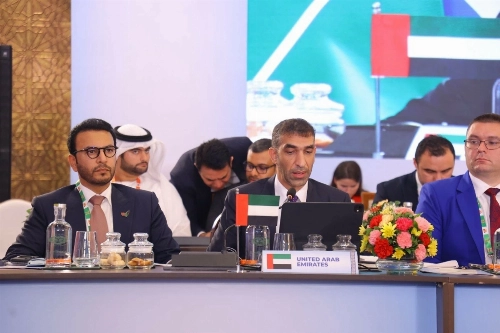
Dr. Thani Bin Ahmed Al Zeyoudi, the UAE Minister of Foreign Trade, attended the 2026 BRICS Trade Ministers Meeting (TMM) hosted by India at the Maharani Mahal, Hotel Sawai Man Mahal, in Jaipur. Accompanied by Abdulla Al Nuaimi, the UAE Ambassador to India, Dr. Al Zeyoudi joined officials from across the BRICS bloc to deliberate on the future of the multilateral trading system, the empowerment of micro, small, and medium enterprises (MSMEs), and the evolution of global value chains in the digital era.
During the summit, the UAE minister held high-level bilateral meetings with several counterparts, including India’s Union Minister of Commerce and Industry Piyush Goyal, China’s International Trade Representative Li Chenggang, and Egypt’s Minister of Investment and Foreign Trade Dr. Mohamed Farid Saleh. Discussions also involved Indonesia’s Trade Minister Dr. Budi Santoso, South Africa’s Minister of Trade, Industry and Competition Parks Franklyn Mpho Tau, and Russia’s Deputy Minister of Economic Development Ilichev Vladimir Evgenievich. These talks were centered on deepening private-sector engagement and expanding cooperation in key economic sectors.
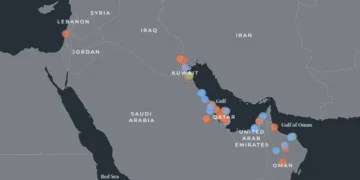
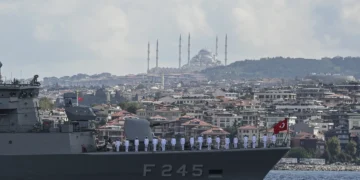
Dr. Al Zeyoudi utilized the platform to express the UAE’s serious concerns regarding the ongoing closure of the Strait of Hormuz and recent attacks on commercial shipping. He reiterated the nation’s demand for the immediate and unconditional reopening of the waterway, emphasizing the necessity of upholding international law to protect global shipping lanes and navigation freedom. While the ministers addressed critical issues such as market connectivity and trade resilience, they were unable to reach a consensus on a final joint declaration.
Reflecting on the meeting, Dr. Al Zeyoudi noted that cooperation between developing economies and emerging markets is vital during periods of global trade uncertainty. He affirmed that the UAE views the BRICS platform as a strategic mechanism for fostering an open, predictable trading environment. The economic data underscores the importance of these ties; in 2025, non-oil bilateral trade between the UAE and BRICS members climbed to over $312 billion, a 28.5% increase from $2024’s $243 billion. These nations currently account for roughly 31% of the UAE’s total non-oil trade, 34% of its imports, and 23% of its non-oil exports.
The UAE’s engagement in Jaipur aligns with its broader Comprehensive Economic Partnership Agreement (CEPA) strategy, which seeks to boost non-oil foreign trade to $1.1 trillion by 2031. Since September 2021, the UAE has finalized 38 such agreements, with 18 currently in force. During his meeting with Piyush Goyal, Dr. Al Zeyoudi reviewed the progress of the India-UAE CEPA, which has been in effect since May 2022. India remains a primary partner, with bilateral non-oil trade reaching $76.2 billion in 2025, marking a 17.3% year-on-year growth.
The BRICS community, which now includes Brazil, Russia, India, China, South Africa, Indonesia, Ethiopia, Egypt, Iran, and the UAE, represents approximately 40% of the world’s population and 25% of global GDP. Complementing these efforts, the UAE recently concluded negotiations for a CEPA with Canada. Announced by Dr. Al Zeyoudi and Canadian Minister of International Trade Maninder Sidhu, this deal represents the fastest negotiation in the UAE’s CEPA program to date. This agreement aims to further bolster bilateral trade, which grew 21% in 2025 to reach $4.2 billion, by eliminating tariffs and reducing bureaucratic barriers for businesses in both nations.
The bilateral meeting with Goyal provided an opportunity to review progress under the India-UAE CEPA, which entered into force in May 2022, and to discuss avenues for expanding cooperation in services trade, digital comm
The BRICS community expanded from five to nine member nations in 2024, with Indonesia joining as its tenth member in 2025.
The conclusion of negotiations represents the fastest achievement within the UAE’s CEPA programme since its launch in September 2021, a testament to the shared ambition and political will on both sides to elevate the bil
Our engagement in Jaipur reinforced the strength of the UAE’s economic relationships with fellow BRICS members, and we are committed to translating these discussions into tangible outcomes for businesses and communities.”
The bilateral meeting with Goyal provided an opportunity to review progress under the India-UAE CEPA, which entered into force in May 2022, and to discuss avenues for expanding cooperation in services trade, digital commerce, logistics, and food security.
Both sides reaffirmed their commitment to advancing trade facilitation and strengthening private-sector collaboration in high-growth sectors.
The conclusion of negotiations represents the fastest achievement within the UAE’s CEPA programme since its launch in September 2021, a testament to the shared ambition and political will on both sides to elevate the bilateral relationship to new heights of economic and investment cooperation.
Source: Gulf Today