







































































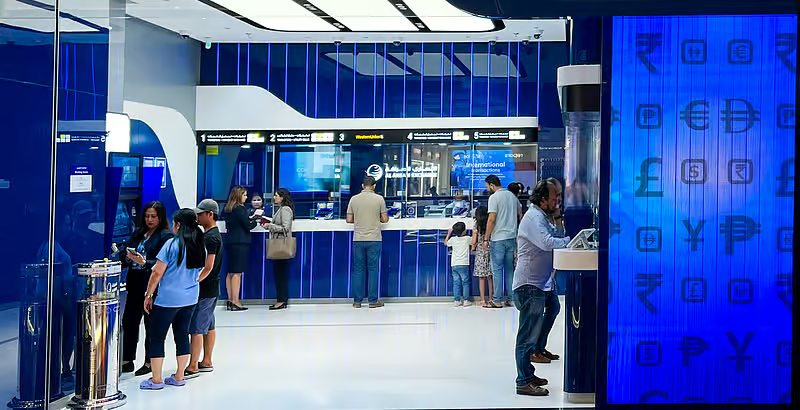
For expatriates living in the UAE during the 1960s, sending money home was a laborious process that often required a three-day wait. Today, that same financial transaction can be completed in as little as three seconds. Rashed A. Al Ansari, Group CEO of Al Ansari Financial Services, recalls the era of paper ledgers, carbon copies, and traveller’s cheques, noting that the speed of modern transfers is such that funds are often credited to a beneficiary’s account before a customer even leaves the branch.
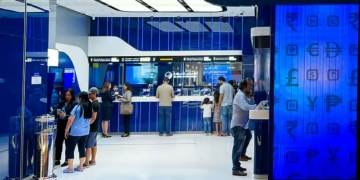
The UAE serves as one of the world’s most significant markets for remittance outflows, with billions of dollars sent abroad annually. This activity is driven by the country’s expatriate population, which accounts for approximately 85 percent of the total residents. Beyond simple money transfers, the financial services sector has modernized to support international travel. The introduction of travel cards has replaced the need for carrying large amounts of physical cash, allowing users to load dirhams, enjoy tourism, and withdraw funds from ATMs as needed.
The origins of Al Ansari Exchange date back to 1966. The founder initially operated in the food trading sector, but recognized a growing demand for remittance services as the UAE’s oil boom attracted a massive influx of foreign workers. Leveraging his existing trade networks, he secured a license in Abu Dhabi five years before the formation of the UAE and established the first branch in the city’s Central Market.
Rashed A. Al Ansari grew up immersed in the family business, often spending his afternoons at his father’s branch after attending Al Ahmadiyah Elementary School. These early experiences, which included answering phones and observing customer interactions, helped instill the core values of reputation, trust, and reliability that continue to define the company today.
Six decades later, the firm has expanded into the UAE’s largest exchange and remittance operator. It currently manages more than 280 branches, with plans to exceed 300 in the near future. The company has also grown its international footprint, establishing a significant presence in Bahrain—where it is the market leader—as well as Kuwait and India. Furthermore, the group recently completed the $200 million acquisition of Bahrain’s BFC Group and is currently awaiting regulatory approval to expand operations into Oman.
The digital landscape for the company shifted dramatically following the onset of the Covid-19 pandemic. In 2018, digital transactions accounted for only 1 percent of the firm’s total volume. That figure has since grown to 30 percent, with projections suggesting it will reach 60 percent within the next five years. Currently, the company’s mobile application processes upwards of 600,000 transactions during peak months. Despite this growth, many customers, particularly labourers and domestic workers, continue to prefer in-person branch visits due to personal preference, language considerations, or limited access to smartphones.
While technology has accelerated transaction speeds, it has also introduced more complex compliance requirements. Rashed notes that the primary obstacle to speed is no longer technical capacity, but the necessity of rigorous regulatory checks. To manage real-time screening of senders and receivers, the company is integrating artificial intelligence to handle tasks like comparing dates of birth, which helps clear false alarms that would otherwise require manual intervention.
As the organization marks its 60th anniversary, Rashed expresses pride in the company’s clean record, noting that it has never been fined by the UAE Central Bank. He emphasizes that the firm strives to act as a benchmark for industry compliance, working closely with regulators to ensure that new mandates do not impose undue burdens on the average consumer. The report also notes that imagine needing cash urgently to send home to a sick family member – and having to wait three days for it to arrive. The report also notes that “I remember it used to take a very long time. The report also notes that driven by technological advancements that have made transfers from the UAE to many recipient countries virtually instant, the UAE’s remittances industry has evolved substantially over the past five decades. The report also notes that importantly, the financial services industry has evolved in multiple direction s. The report also notes that they used to carry a huge stack of cash to hotels and while moving around the country, when families travel l ed to any other country. The report also notes that “See how easy the journey became, and we pride ourselves that we made it so easy for our customers to enjoy their travel when it comes to carrying foreign currency,” added Rashed. The report also notes that with technological advancements comes stricter compliance. The report also notes that the Al Ansari story goes back to 1966.
Source: Khaleej Times