



























































Dearborn, Michigan – Yemeni-American activist Samraa Luqman has no regrets about voting for President Donald Trump in 2024. While the president has been a disappointment to Arab Americans in Michigan with his pro-war and anti-immigration policies, Luqman remains steadfast in her justification for the vote. “There had to be accountability for the genocide. We’re OK with what we voted for,” Luqman told Al Jazeera.
Reflecting on the strategic decision, she added, “I said from the beginning, I’m willing to live through another four years of Trump, that we expected him to be bad on our issues, but it was a pill we were willing to swallow in order to hold the Democratic Party accountable.” This sentiment reflects a broader shift in the community, where the traditional “lesser of two evils” framework has lost its influence.
Democrats’ popularity amongst Arab Americans nosedived in 2024 as President Joe Biden ignored calls to compel a ceasefire in Gaza and continued to provide Israel with weapons and military aid as it killed tens of thousands in Palestine and Lebanon. As the incumbent administration refused to consider an arms embargo, many voters who had historically supported the Democratic Party felt abandoned, leading them to search for alternatives or abstain from the ballot.
Hussein Dabajeh, a prominent political strategist in the Detroit area, noted that the old political calculus no longer applies. “I could not – with a good heart, good conscience – tell someone to vote for Kamala Harris or Donald Trump,” he explained. He emphasized that while Arab voters care about the economy, affordability, and infrastructure like all Americans, they cannot overlook the devastating impact of US policy on Israel.
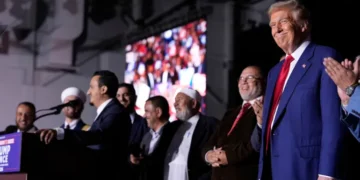
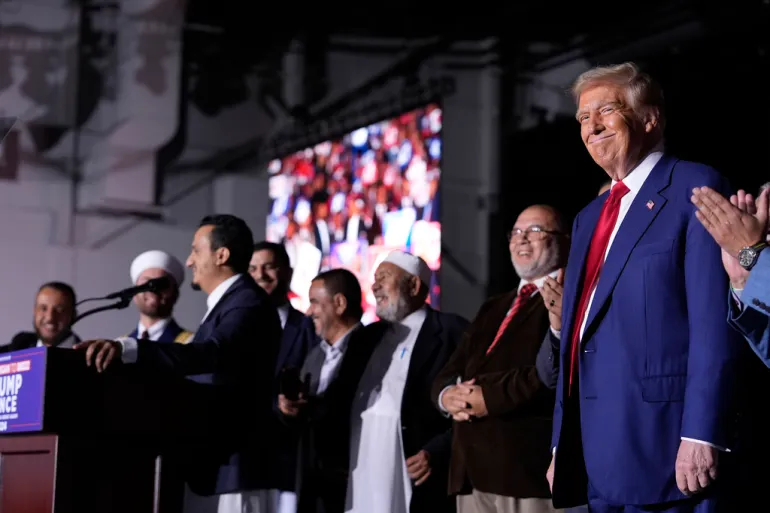
During the 2024 campaign, Donald Trump sought to capitalize on this deep-seated discontent. At a rally in Michigan, Trump brought local Muslim imams to the stage and praised the community. The Republican leader also visited the predominantly Arab and Muslim Detroit suburb of Dearborn ahead of the election, presenting himself as a “peace” candidate to contrast with the Biden-Harris administration.
The electoral impact was significant. According to an Al Jazeera analysis of election results in heavily Arab precincts in east Dearborn, about 45 percent of the votes went to Trump, 29 percent to Green Party candidate Jill Stein, and 16 percent to Harris. This shift allowed Trump to secure a victory in Michigan, as many voters refused to back the Democratic nominee.
However, the honeymoon period for those who supported Trump has been short-lived. As president, Trump has allowed Israel to continue its attacks on Gaza and Lebanon and launched an unprovoked war against Iran. Furthermore, in February, he terminated immigration protections for Yemeni nationals, sowing fear and uncertainty in a community where many leaders had previously endorsed him.
Asked how Arab Americans feel about Trump now, Dabajeh was blunt: “They hate him. There’s no other way of putting it. I don’t think there is any love for him.” Many community members stress that their decision to withhold support for Harris in 2024 was never an endorsement of Trump, but rather a protest against the status quo.
Amer Zahr, a comedian and Dearborn Board of Education trustee, echoed this sentiment. “No one understands the horrors of Trump’s policy more than us. We were his first victims in 2017,” he said, referencing the travel ban on several Muslim-majority countries implemented during Trump’s first term. “No one is more aware of the harm that Trump can cause than we are. But the genocide matured us in a way that we finally realized we had to break the cycle.”
The political environment remains hostile. While Republicans tried to court Arab and Muslim voters in 2024, many conservatives have since returned to demonizing the community as an electoral strategy. For instance, Republican figures have called for the “destruction” of Muslims, and governors in states like Florida and Texas have designated the Council on American-Islamic Relations (CAIR) as a “terrorist” group.
Community activists also point to missed opportunities for engagement. Luqman noted that when Republican officials like John James spoke to community members, they made promises to engage voters in Dearborn, but follow-through has been lacking. “They really missed that opportunity,” she said, highlighting the ongoing frustration with both major parties.
As the election season returns to Michigan, Arab Americans find themselves at a political crossroads. The community is currently rallying behind Democratic Senate candidate Abdul El-Sayed, who has centered his platform on issues relevant to the community. While some voters remain cautious, the focus has shifted toward holding all candidates accountable, ensuring that the Palestinian cause remains a central pillar of their political participation.
Despite Trump’s staunchly pro-Israel policies and unpopular war on Iran, many say supporting Democratic nominee Kamala Harris in 2024 was out of the question, and it was the right choice for the community to break with t
“It has kind of brought the community back to centre, whereas they were kind of swinging to the right by a large margin.”
Advocates say domestic policy takes a backseat when their loved ones are being killed, and their hometowns are being wiped out by their own tax dollars via military aid to Israel.
Some voted for him, while others voted for a third party, left the top of the ticket blank, or skipped the election altogether.
He has also intensified the crackdown on Palestinian rights advocacy at home with a campaign to deport noncitizen student activists critical of Israel.
Luqman, the Yemeni activist, said she will certainly vote for El-Sayed and Congresswoman Rashida Tlaib – who are outspoken critics of Israel – in the Democratic primary on Tuesday and in the general elections in November.
While some political commentators have been questioning why US support for Israel has become a decisive issue in US politics, particularly Democratic primaries, the answer in the Arab community is clear.
“Gaza and Palestine and Middle Eastern issues have now become the forefront, the top of everybody’s issues, and it’s become a red line for my community,” Luqman said.
“So if you’re a Republican or Democrat and you hate AIPAC and you value Palestinians’ rights to self-determination, then you’re going to be getting our vote, regardless of what party you’re in,” she said, referencing the powerful American Israel Public Affairs Committee lobby group.
“People want us not to be single-issue voters.
In other words, they want us to forgo our main issue, get screwed on it, watch our families die because Trump’s bad, and accept all that,” he said.
The blood of the children of Gaza had to mean something.”
Zahr emphasised that Arab Americans are not alone in centring Palestine in their electoral choices, pointing to the defeats that pro-Israel incumbents have suffered across the map in this primary season.
“You’ve gotten to a point where if somebody says, ‘Stop bombing hospitals’, everyone knows you’re talking about Israel.
“And so, people are keying into the truth.
And when you learn the truth, something that comes along with that is you learn that you’ve been lied to, and you get angry.
A lot of righteous anger is pushing a lot of this.”
“Are we supposed to call our family members overseas and be like, ‘Listen, khalto [auntie], this guy over here that’s running for office might kill some of your neighbours, might kill some of your kids, but don’t worry about it, he’s going to take care of the flooding in our homes’?”
Weeks after he was elected, Trump endorsed Randy Fine, a Florida politician with a history of anti-Muslim statements, for Congress.
Source: Aljazeera