















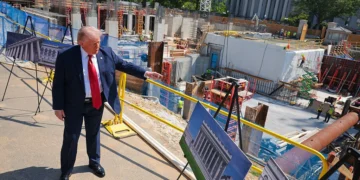









































President Donald Trump has signaled a potential shift in the United States’ approach to the ongoing conflict with Iran, following a week of renewed military hostilities. After Iran launched missile attacks on US military sites in Jordan—a retaliatory move against US strikes on Larak Island—Trump told reporters on Monday that his administration intends to “hit them hard” in response.
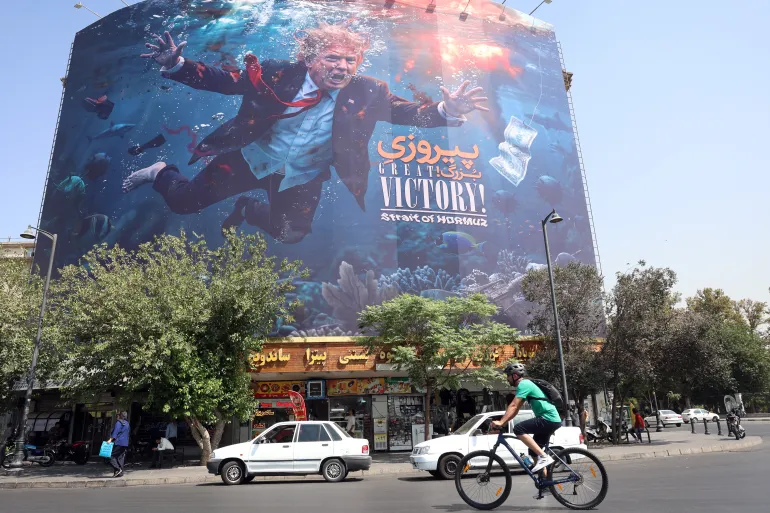
This latest exchange of fire, the first direct confrontation between the two nations in over a month, has intensified concerns that the conflict is entering a more volatile phase. Despite the escalation, Trump maintained that the situation does not necessarily signal a return to full-scale war. Speaking at the White House, he described the Strait of Hormuz as being in “extremely good shape” and claimed that Iran’s military, leadership, and financial systems have been significantly degraded.
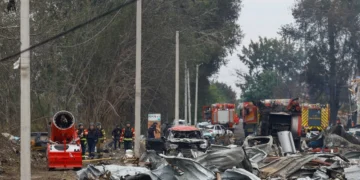
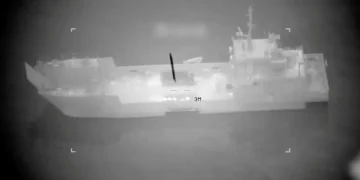
Reports indicate that Washington may be adopting a “no war, no peace” strategy. This approach involves periodic, targeted strikes against Iranian assets without committing to a sustained, all-out military campaign. The US recently targeted two Iranian rocket launchers, which officials alleged were intended for scattering sea mines in the Strait of Hormuz. Iranian media reported that three people were killed in the strikes, while Jordan confirmed it intercepted eight missiles fired at airbases hosting US personnel.
The conflict has evolved through several stages since its inception. It began with a 40-day military campaign, followed by a ceasefire and a subsequent memorandum of understanding (MoU) signed in June. That agreement, intended to facilitate 60 days of peace talks, collapsed within weeks due to disputes over control of the Strait of Hormuz. Since the breakdown of the MoU, Iran has reportedly suspended diplomatic engagement with Washington, maintaining contact only through intermediaries like Oman.
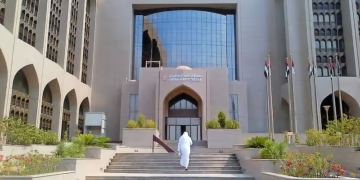
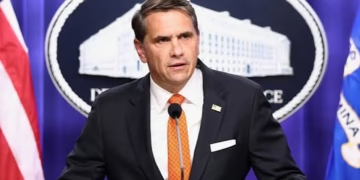
In an effort to exert pressure, the US Treasury recently launched an economic campaign targeting Iran’s global financial interests. Treasury Secretary Scott Bessent stated that the US is sanctioning 60 entities accused of facilitating Iranian oil sales and warned that other nations doing business with Tehran could face secondary sanctions. Bessent argued that Iran is “lashing out kinetically because they are losing economically.” In response, Central Bank Governor Abdolnaser Hemmati dismissed claims of economic collapse, asserting that Iran possesses sufficient foreign currency reserves.
The strategic outlook remains uncertain as both sides continue to demonstrate a willingness to use military force. Iranian President Masoud Pezeshkian, speaking at a Shanghai Cooperation Organisation summit in Bishkek, Kyrgyzstan, stated that his forces would cease fire if the US reciprocated and fulfilled commitments made under the June interim deal. Meanwhile, analysts are questioning the sustainability of the US strategy. Trita Parsi of the Quincy Institute warned that periodic bombing amounts to a “forever war,” suggesting the administration may be abandoning hopes for a definitive military or diplomatic resolution.
Domestic pressures are also mounting, with Trump’s approval rating reportedly falling to 33 percent amid rising petrol prices and the ongoing nature of the conflict. Furthermore, regional dynamics remain complex; Israeli Prime Minister Benjamin Netanyahu has reiterated his determination to prevent Iran from acquiring nuclear weapons, though evidence of an active pursuit remains unverified. Israel has been largely obstructive regarding the June MoU, refusing to withdraw from southern Lebanon despite ceasefire stipulations.
Experts like Mohammad Eslami of the University of Tehran suggest that the current US strategy is rooted in miscalculations regarding the war’s duration. As the conflict enters its seventh month, the risk of further escalation remains high. Observers note that while neither side appears to be seeking an immediate return to total war, the lack of a clear path toward a diplomatic solution leaves the region in a state of precarious, sporadic warfare. The report also notes that in turn, Trump pledged to respond, saying: “ We’re going to hit them hard. The report also notes that however, and largely fell apart because of disagreements arising from its vague wording, that deal has since expired. The report also notes that “That doesn’t mean we won’t smack them. The report also notes that with Tehran again retaliating against US military assets and other infrastructure in neighbouring Gulf countries, that led to a renewal of US attacks on Iran in July. The report also notes that particularly in supplies of critical Patriot interceptor missiles used to defend against Iranian drone and missile strikes, that shift came amid US media reports that its forces were running low on munitions in the Middle East. The report also notes that “I say to the American president that we have enough foreign currency,” he told a news conference.
Source: Al Jazeera