







































































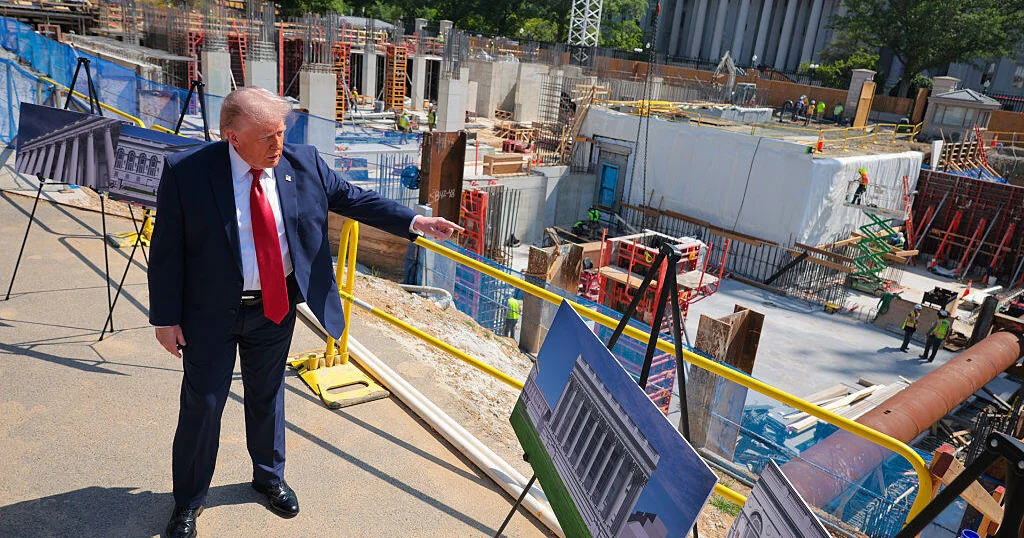
The Supreme Court issued a 5-4 decision on Monday, allowing construction to move forward on a massive new White House ballroom championed by President Trump. The ruling effectively sets aside lower court orders that had previously sought to block the 90,000-square-foot development, which is being built on the former site of the East Wing.
In an unsigned opinion, the high court determined that the National Trust for Historic Preservation, the entity that initiated the lawsuit to stop the project, lacked the legal standing to sue. The court explicitly noted that it was not ruling on the underlying legality of the East Wing project itself, but rather focusing on the procedural merits of the case and the government’s request for emergency relief.
Chief Justice John Roberts authored a dissent, joined by Justices Sonia Sotomayor, Elena Kagan, and Ketanji Brown Jackson. Roberts argued that the ballroom construction is likely unlawful, asserting that Congress has never authorized the project. He further contended that the injuries cited by Trust member Alison Hoagland were sufficient to grant the organization standing, adding that the court’s decision fails to protect the separation of powers regarding the legislature’s control over federal property.
The administration had sought emergency intervention after the U.S. Court of Appeals for the D.C. Circuit ruled that the White House lacked the authority to proceed with the $400 million project without congressional approval. That appellate panel had emphasized that the Constitution grants Congress, not the executive branch, control over federal property and its funding.
Solicitor General D. John Sauer had urged the justices to intervene, describing the injunction as an extraordinary measure that threatened national security. Sauer argued that the project includes a secure subterranean bunker and other essential facilities. He further stated that any pause in construction would jeopardize the President’s safety, citing recent domestic and international assassination threats.
According to filings, the project is currently 65% complete, with a 250-person crew working 20 hours a day, seven days a week. The structure is described as a concrete and steel superstructure that reaches 70 feet in height and extends five stories underground. Joshua Fisher, the director for White House Management and Administration, noted that the project is funded by private donations, with $335 million of the projected $400 million already raised.
The administration expects the structure to be substantially finished by November, with the entire complex slated for completion in August 2028. The court’s majority relied on sworn declarations from senior officials, including the director of National Intelligence and the heads of the Secret Service, Army, and State Department, who warned that halting the work would cause significant harm to national security interests.
President Trump celebrated the court’s decision on social media, describing the project as a “magnificent Ballroom and Military Complex” and labeling it a hallmark of a new “Golden Age of America.” Conversely, attorneys for the National Trust for Historic Preservation had argued that the organization faced irreparable harm and accused the White House of attempting to bypass judicial review.
This legal battle has been ongoing for months, with the Supreme Court having previously allowed work to continue under a temporary stay while it considered the administration’s emergency request. Throughout the process, construction on the underground bunker and other security-related upgrades has remained permitted, even as the broader legal dispute over the ballroom’s authorization continued in lower courts.
The court’s decision concludes that the government is likely to prevail in its arguments regarding standing and the necessity of the stay. While the project moves forward, the fundamental question of whether the executive branch possesses the authority to undertake such a significant structural change to the White House without explicit congressional authorization remains a point of contention between the branches of government. The report also notes that based on the submissions before us, the government is likely to prevail in showing that the Trust lacks Article III standing to challenge the project in federal court and that the remaining stay factors favor relief, we conclude only that. The report also notes that the Court misconceives the plaintiff’s injury, allowing the Executive’s likely infringement of the Legislature’s power of the purse and authority to regulate federal property in the District of Columbia to continue, in failing to appreciate as much. The report also notes that and this Building will be one of the Greatest ever constructed in Washington, D.C.,” he wrote on Truth Social, we are living in the Golden Age of America. The report also notes that the magnificent Ballroom and Military Complex will be something that the entire Country is very proud of, when completed in the Summer of 2028. The report also notes that sauer wrote that the renovations are “absolutely required and should not be enjoined” because any delay threatens Mr. The report also notes that construction on the project is 65% done, Sauer wrote in the filing, because the initial district court order halting the construction has never gone into effect. The report also notes that he revealed that a 250-person crew is working “20 hours a day, 7 days a week. The report also notes that described as a “superstructure” made of concrete and steel, Sauer told the high court that it rises up to 70 feet high in some places, stretches five stories deep and has a footprint of nearly 50,000 square feet.
Source: CBS News