
































































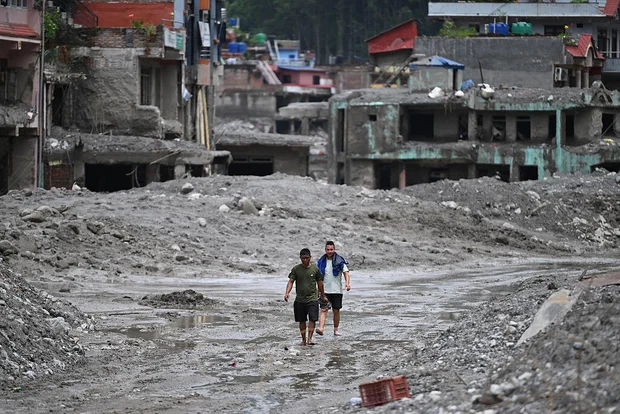
Residents across flood-stricken districts in Nepal remain on high alert for additional flooding as recovery teams work to clear critical infrastructure, including a major highway connecting Kathmandu to the hardest-hit zones. The disaster, triggered by a massive glacial collapse in the Himalayas last Wednesday, has resulted in a confirmed death toll of 903, according to national disaster officials. The number of missing individuals has climbed to 4,247, while authorities across the border in China have reported 16 deaths and 546 missing.
The threat of further inundation remains acute. Early Sunday, emergency alerts were sent to residents following a surge in water levels along the Bhotekoshi River. Dharam Raj Uprety, chief executive of Nepal’s National Disaster Risk Reduction and Management Authority, confirmed that Chinese officials had notified their Nepalese counterparts of increased water flow moving downstream.
For those living in the affected villages, the constant cycle of alerts has become a source of profound exhaustion. Local resident Govind Shreshta described the harrowing experience of repeatedly fleeing to higher ground, often in the middle of the night, while struggling to care for his elderly parents. “It’s really difficult for me. I have a 72-year-old father and 70-year-old mom. I must carry them and I am exhausted,” he said.
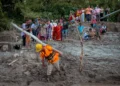
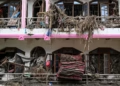
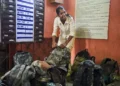
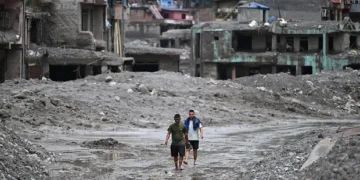
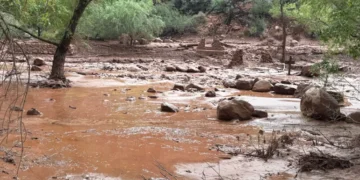
In regions like Dhading, survivors have begun the grim task of returning to their homes to salvage what remains. Many are digging through deep layers of mud and debris to recover personal belongings, while others are searching for livestock. Sharmila Tamang, a resident of the area, expressed the total devastation of the community, stating that nothing of their home remains.
The destruction has also crippled essential services, including a major power plant that served over 20,000 people across four districts. Inspection teams began surveying the damage on Sunday to determine the feasibility of repairs. Meanwhile, the international community is mobilizing support. The U.S. State Department confirmed that 85 American citizens are currently unaccounted for, though nine have been safely evacuated. Spokesperson Tommy Pigott noted that the U.S. is coordinating with the Nepalese government to provide targeted assistance, having already activated $3.6 million in emergency aid, including food supplies for up to 10,000 households.
The search for the missing extends to hundreds of foreign nationals, including workers, tourists, and pilgrims. Chinese state media reported that at least 261 foreigners are missing in Tibet, a group that includes over a hundred Nepalese citizens and individuals from various other nations.
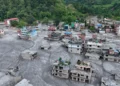
Scientific analysis of satellite imagery indicates that the disaster began when bedrock beneath a Himalayan glacier collapsed, triggering a rockfall with a magnitude of 5.2. The resulting torrent of meltwater and debris surged through valleys, obliterating bridges and buildings in both Nepal and Tibet. While experts caution that it is too early to attribute this specific event directly to climate change, they emphasize that the Himalayas are warming significantly faster than other regions, increasing the frequency of such catastrophic events as global temperatures rise due to human activities.
Addressing the global impact of the crisis, Nepal’s foreign minister, Shisir Khanal, highlighted the country’s vulnerability, noting that despite contributing only 0.1% to global emissions, Nepal is suffering disproportionately from climate-related disasters. In a show of international solidarity, Malaysian Prime Minister Anwar Ibrahim announced on Sunday that his government is deploying a search-and-rescue team to assist with relief and evacuation efforts, alongside a pledge of $1 million in financial aid. The report also notes that residents of the flood-hit villages said they were struggling to make sense of near-constant alarms they’ve received since the initial floods. The report also notes that then we have to run again to higher ground, even at night, sometimes they say a flood is coming. The report also notes that it’s going on like this for those who are still alive. The report also notes that shoveling sludge-like mud and rubble off balconies or window frames, residents sat in homes with walls washed away by the floods. The report also notes that which he found alive, one man had returned for his chickens. The report also notes that he tied them up and put them in the cabin of his truck.
Source: CBS News