








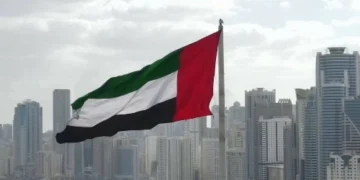






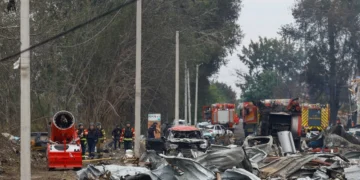


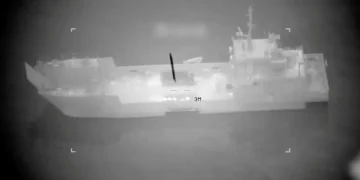








































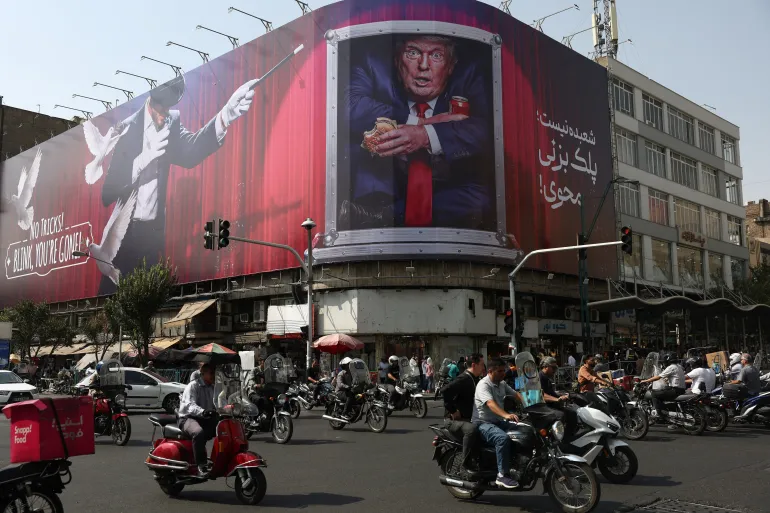
United States President Donald Trump has issued a stern warning that his administration intends to hit Iran hard following a recent escalation in hostilities. The president’s comments arrive in the wake of a fresh exchange of fire, which saw the US military bomb Larak Island in response to Iranian strikes targeting American assets and military bases located in Jordan and the United Arab Emirates.
Addressing reporters from the Oval Office, Trump described the current state of the Strait of Hormuz—a vital waterway blockaded by Tehran since the US-Israel conflict began in February—as being in “extremely good shape.” He noted that the US Navy is actively assisting in the transit of vessels, stating, “We’re taking over. Many, many ships got through last night. As you know, with the navy’s assistance, and we’ve been averaging 30 ships a night.”
The president’s rhetoric remains combative, with Trump telling Fox News that a formal response to the Iranian strikes is forthcoming. This military friction follows a period where the administration had signaled a potential shift toward economic pressure, though the latest combat operations indicate that the risk of sustained conflict remains high in the absence of a permanent ceasefire agreement.
In a social media statement on Monday, Trump characterized the Iranian state as being in a condition of total collapse. He claimed the country is a “Failed Nation” suffering from 300 percent inflation, a non-functional military, and a leadership structure that is incapable of effective governance. He further alleged that the government is only maintaining its grip on power through a brutal crackdown on domestic protesters.
The president asserted that the death toll among Iranian protesters has reached 100,000, a figure significantly higher than the 60,000 he previously cited earlier this year. It remains unclear how the administration arrived at this updated estimate. Conversely, Iranian authorities have reported a death toll of 3,117, including security personnel, and have attributed these casualties to what they describe as Israel-backed rioters.
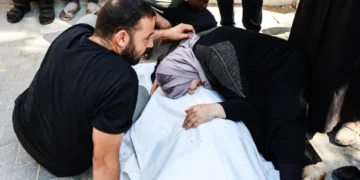
Tehran has vehemently denied the US characterization of the conflict, accusing Washington of committing war crimes and targeting civilian infrastructure. Iranian officials specifically pointed to a strike on the first day of hostilities in Minab, which hit a girls’ school and resulted in the deaths of 168 people, the majority of whom were children.
The Iranian General Staff of the Armed Forces and the Khatam al-Anbiya Central Headquarters issued a joint warning regarding the continued use of regional territory and airspace by the US for offensive operations. While stating that Iran respects the sovereignty of neighboring nations, the military leadership declared that it would not tolerate aggression and warned that any further attacks would be met with a “much heavier” response, ultimately demanding that the US withdraw from the region.
Joey Hood, a former US ambassador to Tunisia and former acting director of the State Department’s Office of Iranian Affairs, suggested that a diplomatic path forward requires regional cooperation. He noted that finding creative solutions, such as an Islamic naval coalition led by nations like Pakistan and Turkiye, could provide a mechanism to monitor the strait and allow both sides to de-escalate the conflict while maintaining their respective positions. The report also notes that claiming it targeted launchers preparing to fire rockets carrying naval mines at the Strait of Hormuz, the US had struck Iran’s Larak Island. The report also notes that they have no Air Force, they have no currency, they are not paying their soldiers or police, Inflation is at 300%, and their leadership is in total disarray and incapable of properly representing the country.”, they have no Navy. The report also notes that “The only thing they have is FAKE NEWS from the USA, a willingness to kill their protesters (now over 100,000 people dead. The report also notes that and a good line of ‘BULL****,’” he wrote, they must be tried for war crimes against humanity!). The report also notes that “It’s going to require countries of the region getting together and finding those creative solutions that would allow both sides to save face and back away from this conflict,” he said.
Source: Al Jazeera