








































































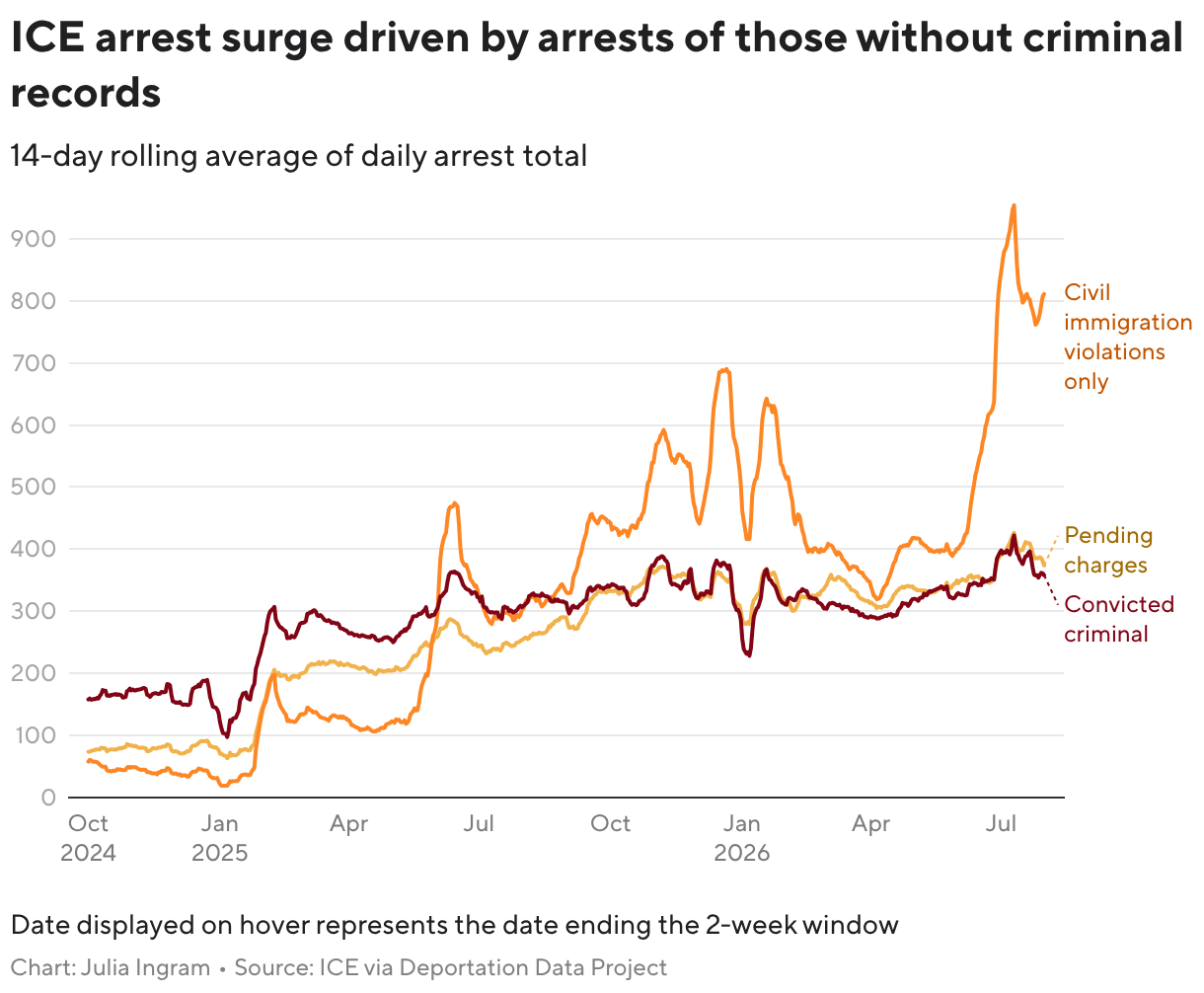
Federal data indicates that Immigration and Customs Enforcement (ICE) reached a record high in July, averaging more than 800 arrests per day of individuals who have no criminal records. This surge aligns with a broader White House initiative to push the agency toward a daily apprehension goal of 2,000 people. July marked the first month of the current administration where individuals facing only civil immigration violations—rather than pending criminal charges or convictions—accounted for more than half of all total arrests.
Overall, ICE averaged more than 1,580 arrests per day throughout July, representing a new peak for the administration. While officials frequently emphasize that their enforcement operations target the “worst of the worst,” data shows that individuals with convictions for violent crimes, as defined by the Bureau of Justice Statistics, comprised only about 6% of all those booked into detention under the current administration, and roughly 4% of those taken into custody during July.
A Department of Homeland Security (DHS) spokesperson stated that ICE enforces the law as written, noting that immigration status alone is the primary factor for enforcement. The agency argued that many individuals categorized as non-criminals may still have histories involving gang affiliation, human rights abuses, or terrorism, even if they lack a formal criminal record within the United States. This data was obtained from ICE by the Deportation Data Project, a research initiative led by UCLA and the University of California, Berkeley.
Administration officials, including White House border czar Tom Homan and Homeland Security Secretary Markwayne Mullin, have argued that sanctuary policies in certain jurisdictions force federal agents to deploy more resources to those areas to locate their targets. Mullin recently urged state governors to increase cooperation with federal immigration authorities, suggesting that such collaboration would reduce the need for a broader federal presence in their communities.
Despite these claims, analysis of June and July data suggests that enforcement is not limited to sanctuary jurisdictions. Areas without such policies, such as Florida, experienced a significant increase in street-level arrests. For instance, Jacksonville saw average monthly arrests rise from 18 to 166, while Miami’s average grew from 115 to 715. Similarly, community arrests in Texas cities like Austin and El Paso tripled during this period.
Some jurisdictions with sanctuary policies also saw notable spikes. Arrests in San Ysidro, California, were more than six times higher than in previous months, while figures in Denver and Newark doubled. This uptick has occurred without the use of highly publicized city-wide crackdowns, as agents increasingly rely on traffic stops, airport operations, and arrests at immigration check-ins. Recent incidents involving the deaths of two immigrants during traffic stops in Maine and Texas have drawn significant public scrutiny.
Community-based enforcement accounted for nearly half of all ICE arrests in June and July, totaling at least 45,300 cases. An additional 12,700 arrests were linked to 287(g) agreements, which empower local law enforcement to assist in immigration enforcement. ICE currently maintains these agreements with over 1,850 agencies, a program the DHS is actively expanding with $1.15 billion in funding allocated through September 2027. The report also notes that a funding standoff and a shake-up in DHS leadership, enforcement ramped up this summer after a drop following public backlash to the Department of Homeland Security’s operation in Minneapolis. The report also notes that what makes someone a target for immigration enforcement is whether or not they are illegally in the U.S.— full stop,” a DHS spokesperson said in a statement to. The report also notes that human rights abusers, gangsters and more; they just don’t have a rap sheet in the U.S, many of the individuals that are counted as ‘non-criminals’ are actually terrorists. The report also notes that asked DHS to provide that data. The report also notes that you probably won’t even see us at all. The report also notes that compared with a 50% increase everywhere else, ‘ analysis of the data found, those cities and states saw a 27% increase in street arrests during those months compared to the previous six.
Source: CBS News