



























































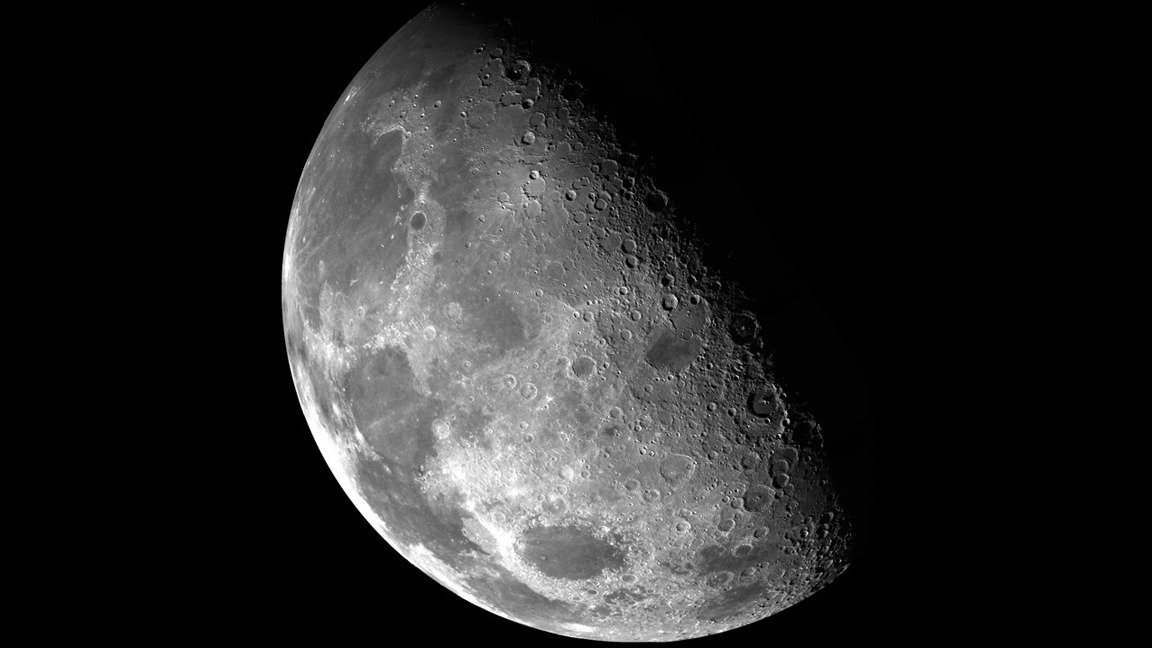
The Moon is the Earth’s only natural satellite, which has been orbiting our planet for millions of years. According to scientists, the age of the Moon is about 4.5 billion (4.5 billion) years, which is close to the age of the Earth.
Research says that when the Earth was just forming, a cosmic object the size of Mars collided with the Earth. As a result of this huge collision, some parts of the Earth were thrown into space and gradually they came together to form the Moon. Scientists call this event the Giant Impact Hypothesis.
The Moon is located on average about 384,400 kilometers from the Earth and it rotates in a specific orbit around the Earth. It takes about 27.3 days for the Moon to complete a full orbit, but we see the different phases of the Moon from full moon to full moon in about 29.5 days.
Another interesting fact is that the Moon always shows us the same side of the Earth. This is because its rotation and orbital periods are almost the same, which is called “tidal locking.” As a result, we never see the far side of the Moon directly.
The Moon not only adds to the beauty of the sky, it is also very important for the Earth. The Moon’s gravitational pull causes ocean tides and helps stabilize the Earth’s rotation, which is very important for our climate and life.